
What's Happening?
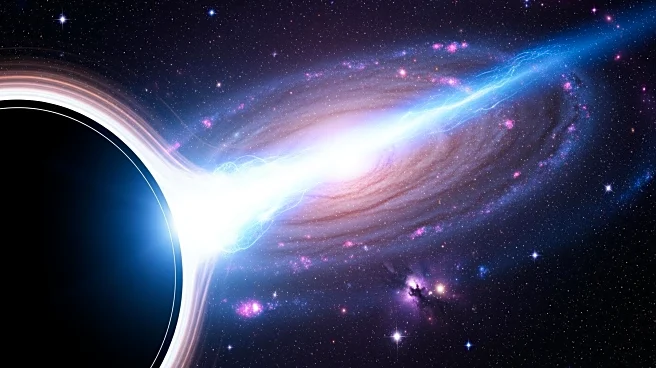
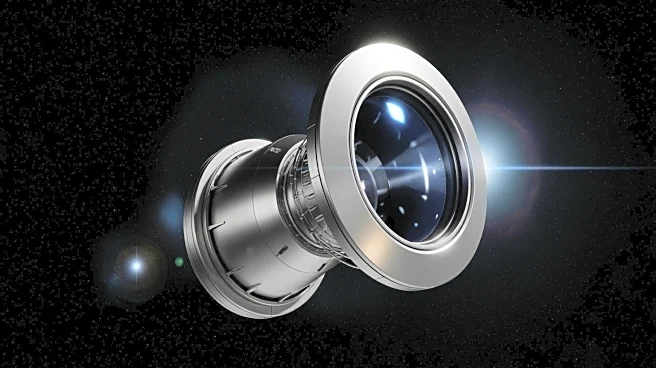
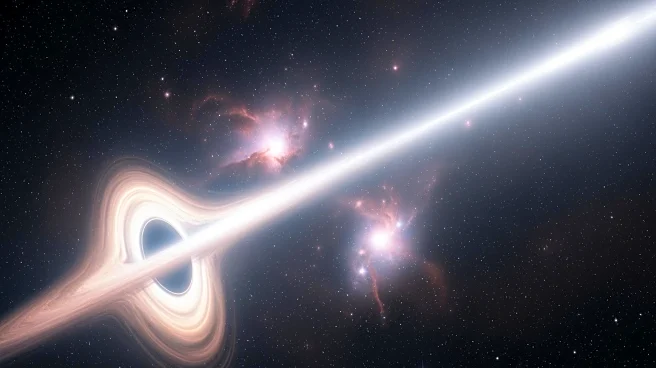
Astronomers have successfully tracked a 3,000 light-year-long cosmic jet back to its source, the supermassive black hole M87*, using the Event Horizon Telescope (EHT). M87*, located at the center of the galaxy
Messier 87, was the first black hole to be imaged by humanity. The black hole, with a mass equivalent to 6.5 billion suns, is known for its active nature, consuming surrounding gas and dust while launching powerful jets from its poles. The exact mechanism behind these jets has been a mystery. Recent observations using Very Long Baseline Interferometry (VLBI) have allowed scientists to connect the glowing ring of material around M87* to the base of the jet, providing insights into the jet's origin. This study marks a significant step in understanding the processes that power these cosmic phenomena.
Why It's Important?
The ability to trace the origins of cosmic jets from supermassive black holes like M87* is crucial for understanding the role these entities play in shaping their surrounding environments. These jets can influence galaxy formation and evolution by distributing energy and matter across vast distances. The findings could lead to advancements in theoretical models of jet formation and provide a deeper understanding of the dynamics at play in the universe. This research not only enhances our knowledge of black holes but also contributes to the broader field of astrophysics, potentially impacting future studies and technologies related to space exploration and observation.
What's Next?
The research team plans to conduct further observations of M87* to gain a more detailed understanding of the jet's structure and its interaction with the surrounding environment. These efforts aim to refine the models of jet formation and improve the accuracy of predictions regarding the behavior of supermassive black holes. Continued advancements in telescope technology and observational techniques will likely play a key role in these future studies, potentially leading to new discoveries about the universe's most enigmatic objects.