







What's Happening?
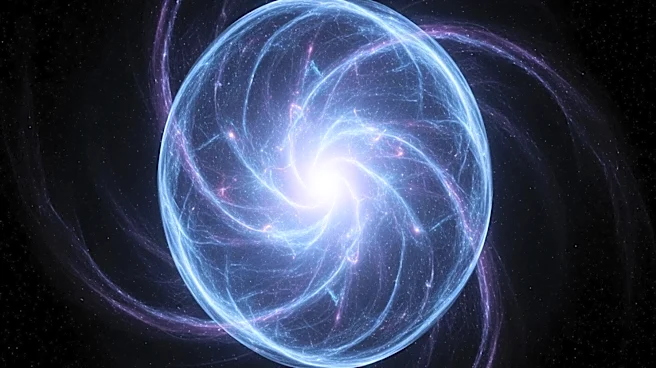
The Gemini North telescope in Hawaii has captured a breathtaking image of the Crystal Ball Nebula, also known as NGC 1514, located approximately 1,500 light-years away in the constellation Taurus. This planetary nebula consists of two stars orbiting each
other every nine years. According to the U.S. National Science Foundation's NOIRLab, one of these stars, once several times more massive than the sun, is in the process of dying and has begun releasing its outer layers. As the stars orbit, they shape the expanding shell of gas with their strong, asymmetrical winds, creating the lumpy layers visible in the image. This phenomenon provides a unique glimpse into the life cycle of stars and the formation of planetary nebulas.
Why It's Important?
The image of the Crystal Ball Nebula serves as a powerful reminder of the beauty and complexity of cosmic phenomena. It highlights the process by which stars end their life cycles, shedding light on the formation of planetary nebulas. This observation is significant for astronomers as it offers insights into stellar evolution and the dynamics of binary star systems. The ability to capture such detailed images from Earth-based telescopes underscores the advancements in astronomical technology and the importance of continued investment in space observation. Additionally, the image serves as a historical record, as the light from the nebula took 1,500 years to reach Earth, allowing scientists to study the past states of these celestial bodies.
Beyond the Headlines
The Crystal Ball Nebula image not only captivates with its visual appeal but also prompts deeper questions about the universe's history and future. It exemplifies how astronomical observations can serve as time capsules, offering a window into the past. This perspective can influence how we understand the universe's evolution and our place within it. The study of such nebulas can also inform theories about the fate of our own solar system, as our sun will eventually undergo a similar transformation. The cultural and philosophical implications of observing the cosmos in this way continue to inspire curiosity and wonder about the universe.