



What's Happening?
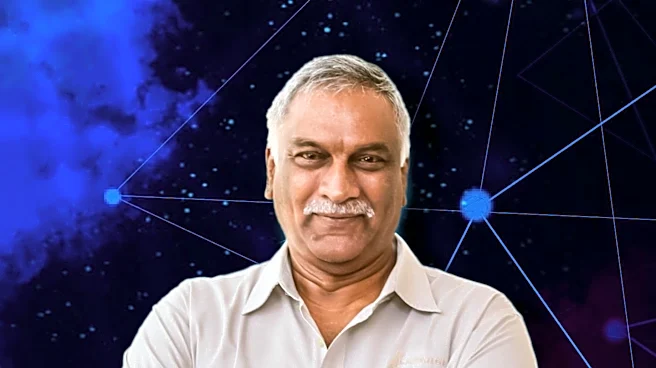
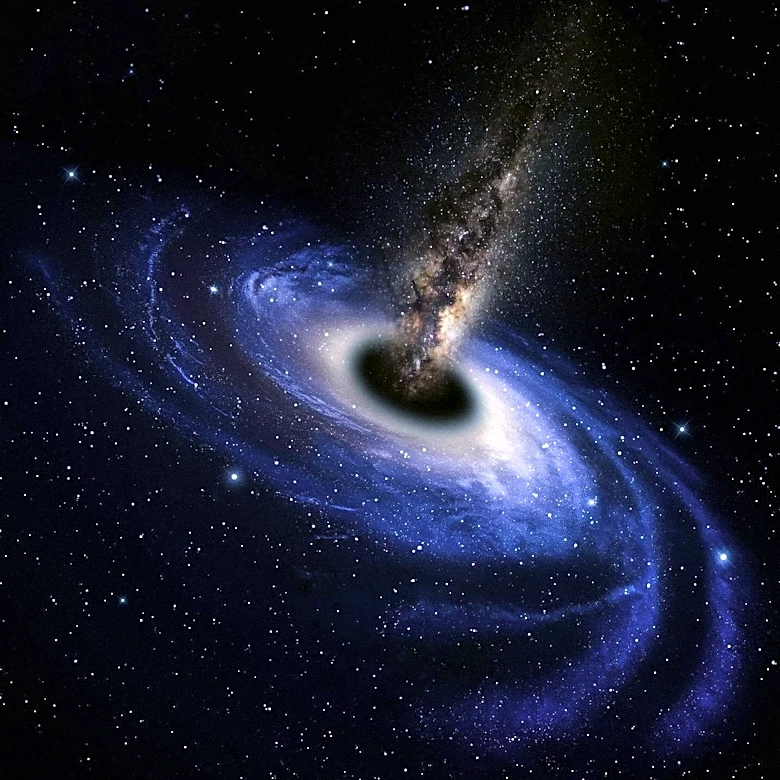
Indian theoretical physicist Ashoke Sen has been recognized with the 2026 Oskar Klein Medal for his significant contributions to understanding black holes, particularly his work on black-hole entropy using string theory. Black holes, characterized by
immense gravity that prevents light from escaping, remain a major enigma in modern physics. Sen developed mathematical methods to investigate black-hole entropy and count microscopic states within specific theoretical systems. His research has enabled scientists to compare calculations derived from string theory with predictions from gravitational physics. These calculations are crucial for connecting the large-scale properties of black holes with their underlying quantum descriptions. Sen's work, while advancing theoretical understanding, applies to particular theoretical cases and does not yet encompass every black hole observed in the universe.
Why It's Important?
Ashoke Sen's research is vital for bridging the gap between quantum physics and gravitational forces, two fundamental pillars of modern physics that are notoriously difficult to reconcile. Black-hole entropy, linked to the area of a black hole's event horizon, poses a fundamental question: what microscopic states account for this entropy? By providing mathematical tools to explore this question, Sen's work helps physicists investigate how the microscopic properties of black holes relate to their observable characteristics. This advancement is a step towards a unified theory of quantum gravity, which seeks to describe gravity at the quantum level. The recognition of his work with the Oskar Klein Medal underscores the global significance of his contributions to fundamental physics and the ongoing quest to understand the universe's most extreme phenomena.
What's Next?
While Ashoke Sen's research has significantly advanced the theoretical understanding of black holes, it has not yet led to experimental confirmation of string theory or resolved all questions surrounding these cosmic objects. Scientists will continue to investigate how quantum information behaves in extreme gravitational conditions, building upon Sen's mathematical frameworks. Future research will likely focus on refining these theoretical models and seeking ways to test them through astronomical observations or particle physics experiments. The ongoing challenge is to develop a comprehensive understanding of black holes that integrates both quantum mechanics and general relativity. Sen's work provides a crucial foundation for these future endeavors, guiding researchers in their exploration of the universe's most profound mysteries.
Beyond the Headlines
Ashoke Sen's work delves into the philosophical and conceptual depths of physics, addressing the very nature of reality at its most fundamental level. By connecting black-hole entropy to microscopic states, his research touches upon the idea that even the most seemingly simple macroscopic properties of the universe might arise from complex underlying quantum arrangements. This pursuit of understanding the 'hidden' aspects of black holes, such as their internal quantum structure, pushes the boundaries of human knowledge. The recognition of an Indian physicist with such a prestigious international award also highlights the global nature of scientific inquiry and the diverse contributions from researchers worldwide in unraveling the universe's secrets. His work encourages a deeper appreciation for the intricate interplay between mathematics, theoretical physics, and our quest to comprehend the cosmos.