







What's Happening?
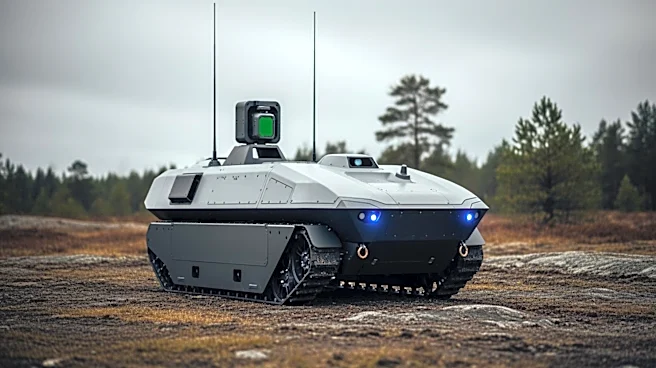
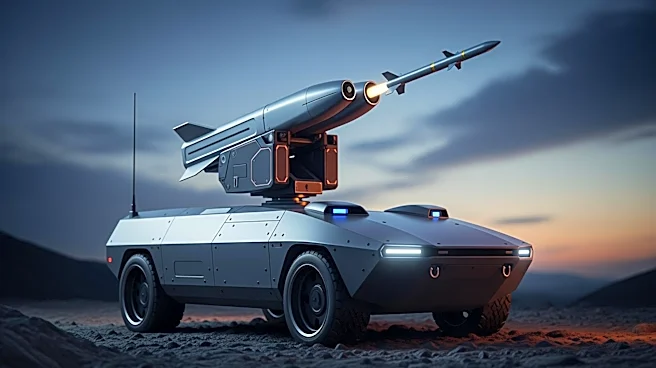
German defense company Diehl Defense, in collaboration with Rafael Advanced Defense Systems and EuroSpike GmbH, has successfully conducted firing tests of the Spike LR guided missile from the Ziesel unmanned ground vehicle (UGV). This marks the first
instance of the missile being launched from an unmanned platform. Over a five-day period, 17 guided missiles were fired, demonstrating the platform's robust performance. The tests follow the public unveiling of the Ziesel with the Spike launcher at Enforce Tac 2025 in Nürnberg. The Ziesel UGV, a compact tracked platform, is designed for logistics, casualty evacuation, and reconnaissance, and is equipped with an autonomy kit for fully autonomous navigation. The Bundeswehr, Germany's armed forces, is aiming to enhance its military capabilities with a focus on technology and innovation by 2039.
Why It's Important?
The successful integration of the Spike missile with the Ziesel UGV represents a significant advancement in military technology, particularly in the realm of unmanned systems. This development could transform anti-tank warfare by allowing strikes on armored formations from a distance without endangering soldiers. The use of UGVs in combat operations is becoming increasingly important as they offer new capabilities in logistics, electronic warfare, and casualty evacuation. The adoption of such technologies by the Bundeswehr aligns with Germany's strategy to strengthen its military forces and enhance its technological capabilities, potentially influencing military strategies and defense policies across Europe and beyond.
What's Next?
The Ziesel UGV is currently undergoing testing by several armed forces, including those of Germany and Ukraine. As these tests continue, the platform's capabilities and potential applications in various military operations will be further evaluated. The integration of advanced missile systems like the Spike into unmanned platforms could lead to broader adoption of such technologies by NATO forces and other military organizations worldwide. This could prompt further investments in unmanned systems and drive innovation in military technology, potentially reshaping the landscape of modern warfare.