



What's Happening?
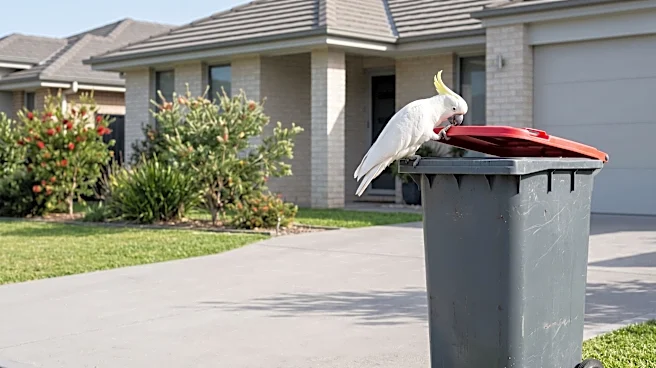
Sulphur-crested cockatoos in Sydney, Australia, have developed a complex behavior of opening household wheelie bins to access discarded food. This behavior, which involves gripping the lid with their beak, raising it, repositioning, and shuffling along
the rim to flip it open, was reported in only three Sydney suburbs before 2018. By late 2019, the behavior had spread to 44 suburbs, primarily moving into neighboring areas. A 2021 paper in Science concluded that social learning, rather than genetic inheritance, was the primary driver of this spread, accounting for the behavior reaching 93.9% of the affected suburbs. Researchers observed that birds in different locations developed distinct techniques for opening bins, indicating the formation of local foraging cultures. The study involved online surveys with 1,322 participants providing 1,396 reports across 478 suburbs, and direct observations of marked cockatoos to analyze their methods.
Why It's Important?
This phenomenon provides compelling evidence of cultural transmission in a non-human species, demonstrating how complex skills can spread and evolve within animal populations through social learning. The cockatoos' adaptation to an urban environment by exploiting a new food source highlights their cognitive flexibility and problem-solving abilities. The development of 'local accents' in their bin-opening techniques further underscores the cultural aspect, showing that behaviors are not merely copied but can be modified and refined within specific groups. This research contributes significantly to the understanding of animal intelligence and the mechanisms of cultural evolution, challenging the notion that complex cultural behaviors are exclusive to humans. It also illustrates how human infrastructure and waste management practices can inadvertently create new ecological niches and behavioral adaptations in urban wildlife, leading to novel interactions between species and their environment.
What's Next?
The ongoing interaction between cockatoos and human residents is likely to continue evolving. As cockatoos refine their bin-opening techniques, residents are already developing countermeasures, such as placing bricks, water bottles, or commercially available devices on bin lids. This has been described as a potential 'interspecies innovation arms race,' where the birds' cultural adaptations trigger behavioral changes in humans, which in turn create new challenges for the cockatoos. Future research may focus on the long-term sustainability of these cockatoo foraging cultures, the impact of human countermeasures on their behavior, and whether new innovations in bin-opening or other urban foraging strategies emerge. The study also opens avenues for investigating how such cultural learning might influence other aspects of cockatoo social structure and population dynamics in urban settings.
Beyond the Headlines
The cockatoo's bin-opening culture offers a fascinating lens through which to examine the broader implications of human-wildlife interaction in increasingly urbanized landscapes. It highlights how human activities, such as waste disposal, can inadvertently shape the evolutionary and cultural trajectories of other species. The 'arms race' between cockatoos and residents also raises ethical questions about co-existence and the management of urban wildlife. It prompts reflection on whether humans have a responsibility to adapt their practices to minimize conflict or to actively deter behaviors that are perceived as nuisances. Furthermore, the study's findings on social learning and cultural transmission in animals could have implications for conservation efforts, suggesting that understanding and leveraging social dynamics within animal populations might be crucial for promoting adaptive behaviors in response to environmental changes or threats.