



What's Happening?
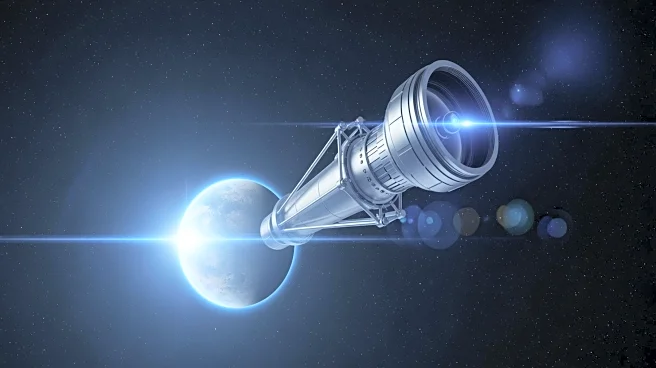
NASA has launched the Pandora mission to complement the James Webb Space Telescope's efforts in studying exoplanets. The Pandora satellite, launched from Vandenberg Space Force Base aboard a SpaceX Falcon 9 rocket, aims to provide additional data to refine
Webb's observations. The mission focuses on detecting water and other molecules in the atmospheres of exoplanets, which can be obscured by stellar contamination. Pandora's smaller size and budget, compared to Webb, allow it to focus on specific tasks that enhance the precision of Webb's findings. The mission is expected to help astronomers better understand the atmospheres of planets orbiting small dwarf stars, which are prime candidates for finding Earth-like conditions.
Why It's Important?
The Pandora mission is crucial for maximizing the scientific output of the James Webb Space Telescope, particularly in the search for habitable exoplanets. By providing context and additional data, Pandora helps ensure that the detection of water and other life-indicating molecules is accurate and not confused with signals from the host stars. This collaboration between Pandora and Webb could significantly advance our understanding of distant planetary systems and the potential for life beyond Earth. The mission's success could lead to more precise identification of exoplanets with conditions similar to Earth, influencing future space exploration and research priorities.
What's Next?
Following its launch, Pandora will undergo a series of commissioning and calibration steps before beginning its scientific observations. The mission will focus on analyzing the atmospheres of exoplanets, particularly those orbiting red dwarf stars. As data from Pandora and Webb are combined, astronomers anticipate more accurate assessments of exoplanetary atmospheres, potentially leading to the discovery of new Earth-like planets. The findings could influence future missions and the development of new technologies for space exploration.