





What's Happening?
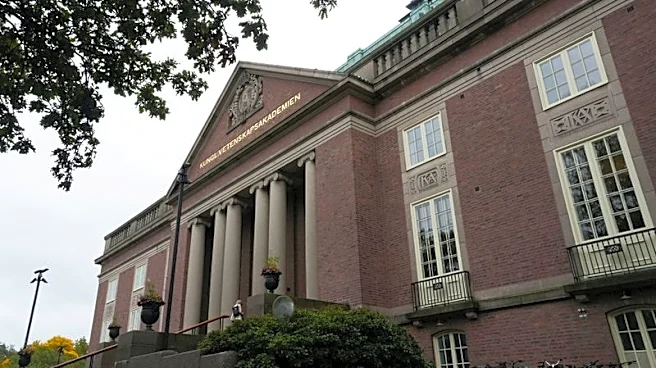
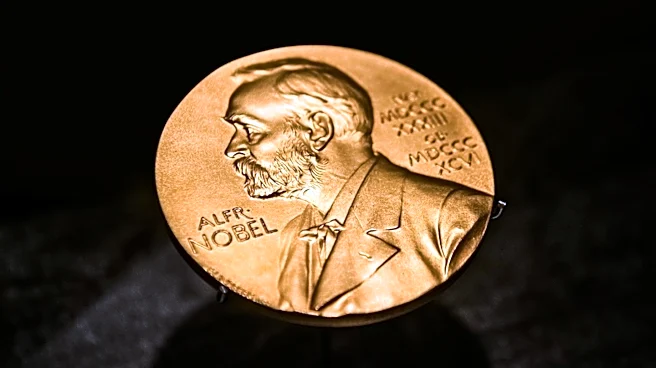
The journey of Nobel laureate John Fenn, who received the 2002 Nobel Prize in Chemistry for developing electrospray ionization mass spectrometry (ESI-MS), is detailed, including his health challenges during the Nobel ceremony in Stockholm. Fenn, at 85
years old, experienced heart failure during the events but managed to perform his duties, including receiving the medal from the King and reciting a poem. His former student, Michael Labowsky, had to substitute for him to deliver a second lecture at Uppsala University due to Fenn's hospitalization. The account also highlights Fenn's pioneering work in molecular beams and his dedication to his students.
Why It's Important?
This narrative provides a unique insight into the personal challenges faced by a Nobel laureate during one of the most significant moments of his career. It underscores the human element behind scientific achievements and the dedication required, even in advanced age. For the U.S. scientific community, Fenn's story exemplifies the long-term impact of fundamental research, as ESI-MS became indispensable in biomedical and pharmaceutical research. His work, primarily developed in U.S. academic institutions like Yale and Princeton, showcases American contributions to global scientific advancements and the importance of mentorship in fostering scientific breakthroughs.
What's Next?
While John Fenn passed away in 2010, his legacy continues through the widespread application of ESI-MS in various scientific fields. The story serves as an inspiration for current and future scientists, emphasizing perseverance and the profound impact of scientific discovery. Academic institutions and scientific organizations will continue to honor his contributions, and his work will remain a cornerstone in analytical chemistry, influencing ongoing research and technological developments in the U.S. and worldwide.
Beyond the Headlines
John Fenn's story goes beyond the scientific achievement, revealing the profound human spirit and the values of integrity and mentorship. His concern for his students and his humility, even at the pinnacle of his career, offer valuable lessons in academic leadership. The account also subtly touches upon the ethical considerations in scientific recognition, as Fenn was always quick to credit others, including Malcolm Dole, whose earlier work laid some groundwork for ESI-MS. This narrative highlights the collaborative and often serendipitous nature of scientific progress, where individual brilliance is often intertwined with the contributions of many, and the importance of recognizing those contributions fairly.