




What's Happening?
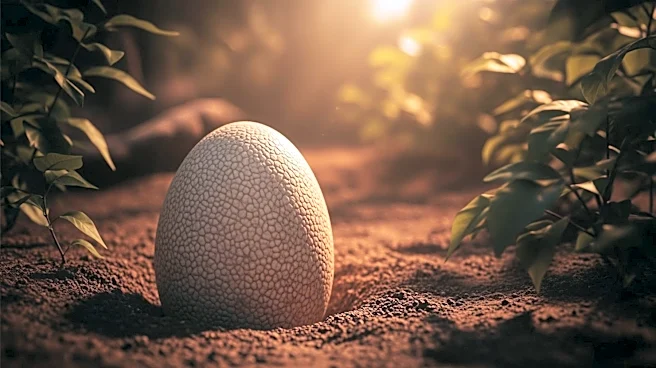
A team of researchers in Taiwan has recreated a life-sized oviraptor nest to study how these ancient dinosaurs incubated their eggs. The study, published in Frontiers in Ecology and Evolution, suggests that oviraptors relied more on environmental heat,
such as sunlight, rather than body warmth to incubate their eggs. This method contrasts with modern birds, which use thermoregulatory contact incubation. The researchers found that in colder conditions, eggs in the outer ring of the nest were significantly cooler than those in the inner ring, leading to asynchronous hatching. In warmer conditions, the temperature difference was minimal, indicating a reliance on environmental heat.
Why It's Important?
This discovery provides new insights into the nesting behaviors of oviraptors, a topic that has long been debated due to limited fossil evidence. Understanding these behaviors helps paleontologists draw parallels between ancient and modern species, offering a glimpse into evolutionary adaptations. The study also highlights the importance of environmental factors in the survival and development of species, which can inform current conservation efforts. By understanding how ancient species adapted to their environments, scientists can better predict how modern species might respond to climate change.
What's Next?
Further research could explore other dinosaur species to see if similar incubation methods were used. This could involve more detailed simulations and comparisons with fossil records. Additionally, the findings may prompt a reevaluation of how environmental changes affected dinosaur populations and their eventual extinction. Researchers might also investigate how these incubation strategies influenced the evolutionary paths of birds and reptiles.
Beyond the Headlines
The study raises questions about the efficiency of different incubation methods and their evolutionary advantages. While modern birds have evolved to use direct contact incubation, the oviraptors' method may have been more suited to their specific environmental conditions. This research could lead to a broader understanding of how different species have adapted their reproductive strategies over time.