





What's Happening?
Astronomers have identified a third galaxy, NGC 1052-DF9, that appears to lack a significant dark matter halo, joining two previously discovered galaxies, DF2 and DF4. These galaxies are aligned along a narrow line in the NGC 1052 field, suggesting a common
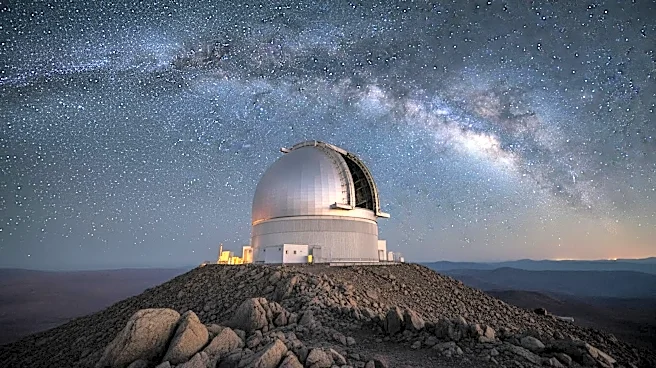
origin. The discovery was made using the W. M. Keck Observatory, where researchers measured the internal motions of DF9 and found its stars moving too slowly to be influenced by a typical dark matter halo. This finding supports the hypothesis that these galaxies were formed from a high-speed collision between two gas-rich galaxies, which separated ordinary matter from dark matter. The study, published in The Astrophysical Journal, highlights the unusual nature of these galaxies, which are thought to have formed in a violent event that left them without the dark matter halos typically found in galaxies of their size.
Why It's Important?
The discovery of galaxies lacking dark matter is significant as it challenges existing models of galaxy formation and the role of dark matter. Typically, dark matter is believed to outweigh visible matter in galaxies, providing the gravitational pull necessary for their formation and stability. The existence of galaxies like DF9, DF2, and DF4, which appear to have formed without dark matter, suggests alternative formation processes and provides evidence supporting the existence of dark matter as a separate substance. This finding could lead to a deeper understanding of dark matter and its interactions, potentially impacting theories of cosmic evolution and the fundamental nature of the universe.
What's Next?
Future research will focus on confirming the absence of dark matter in other galaxies along the same line as DF9, DF2, and DF4. Additionally, astronomers aim to detect any remaining gas from the hypothesized collision, which would serve as 'smoking gun' evidence for the collision theory. These efforts will help determine whether these galaxies are truly unique or part of a broader pattern, further informing our understanding of dark matter and galaxy formation.