



What's Happening?
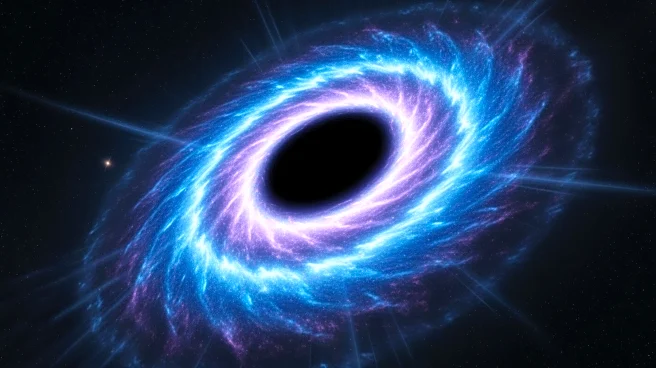
An international team of astronomers, led by researchers at the National Observatory of Athens, has found evidence suggesting that the material surrounding supermassive black holes has changed over billions of years. This challenges the long-standing
assumption that the relationship between ultraviolet and X-ray emissions from quasars is universal. The study, published in the Monthly Notices of the Royal Astronomical Society, indicates that this relationship was different when the universe was younger, suggesting changes in the accretion disk and corona interactions over time. The findings were based on data from the eROSITA X-ray telescope and the XMM-Newton observatory.
Why It's Important?
The discovery has significant implications for cosmology, as it questions the universality of the ultraviolet and X-ray relationship in quasars, which has been used to map the universe's shape and study dark matter and energy. This could lead to a reevaluation of methods that rely on quasars as standard candles. Understanding the evolution of black hole environments is crucial for comprehending how supermassive black holes grow and radiate, potentially altering foundational concepts in astronomy.
What's Next?
Future observations from upcoming eROSITA all-sky scans and next-generation X-ray surveys will aim to confirm whether the observed changes reflect real physical evolution or are influenced by data collection methods. These efforts will provide deeper insights into the behavior of supermassive black holes and their impact on the universe's evolution, potentially leading to new models and theories in astrophysics.