


What's Happening?
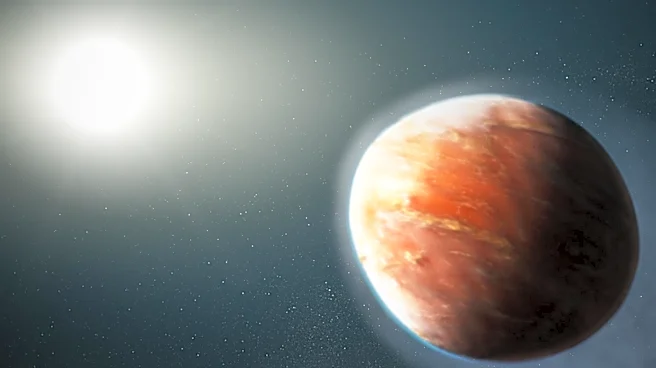
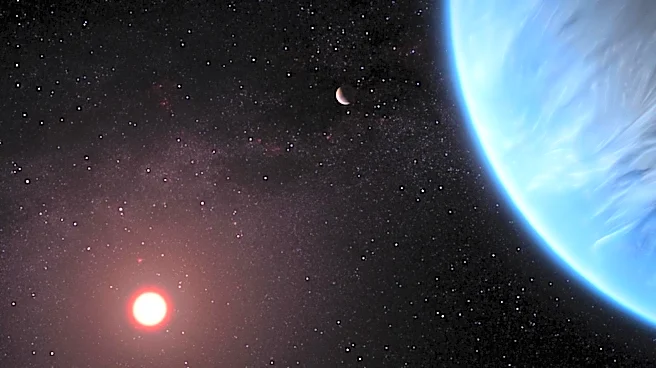
New research investigates an observational strategy that combines data from the James Webb Space Telescope (JWST) and the Hubble Space Telescope (HST) to improve the characterization of exoplanet atmospheres. This approach aims to address systematic biases
in models caused by the Transit Light Source Effect, where stellar features like spots and faculae influence exoplanet transmission spectra. By integrating simultaneous observations from both telescopes, scientists can obtain broader wavelength coverage, particularly extending into the optical and ultraviolet spectrum. This broader coverage is crucial for disentangling degeneracies between stellar contamination and planetary parameters, which is a limitation when using JWST data alone, as it is restricted to wavelengths redder than 0.6 microns. The study performs synthetic retrievals to demonstrate how this combined data can better constrain starspot and faculae parameters, test the impact of different model spectra, and consider the effect of variable stellar activity on co-adding transits to achieve desired signal-to-noise ratios. The findings indicate that ultraviolet and optical wavelengths are key to resolving ambiguities in stellar contamination and planetary characteristics.
Why It's Important?
This research is important for advancing the field of exoplanet characterization, particularly in the U.S.-led space exploration efforts. The ability to more accurately determine the atmospheric composition and properties of exoplanets is fundamental to understanding planetary formation, evolution, and the potential for life beyond Earth. By improving the precision of atmospheric retrievals, scientists can overcome current limitations posed by stellar activity, which often mimics or obscures true planetary signals. This enhanced understanding will directly impact the interpretation of data from cutting-edge observatories like JWST, maximizing the scientific return on significant investments in space infrastructure. More precise data will enable more reliable conclusions about exoplanet habitability and atmospheric chemistry, influencing future mission designs and research priorities in astrobiology and planetary science.
What's Next?
The proposed observational strategy suggests a path forward for future exoplanet studies. The next steps will likely involve implementing this combined observation approach in actual astronomical campaigns, coordinating simultaneous data collection from JWST and HST for specific exoplanet targets. Further development and refinement of retrieval algorithms will be necessary to effectively integrate and analyze the multi-wavelength data. Researchers will also need to continue validating and improving models of stellar spectra and activity to ensure the accuracy of the derived planetary parameters. The success of this strategy could lead to a paradigm shift in how exoplanet atmospheres are studied, potentially revealing new insights into the diversity of planetary systems and the conditions necessary for life. This could also inform the design of future telescopes and instruments, emphasizing the need for broad spectral coverage.
Beyond the Headlines
Beyond the immediate scientific implications, this research highlights the critical role of international collaboration and the synergistic use of advanced astronomical facilities. The combined power of JWST and HST underscores the value of maintaining and upgrading existing infrastructure while developing new technologies. This approach also touches upon the broader challenge of data interpretation in complex scientific fields, where subtle biases can significantly alter conclusions. The need for sophisticated retrieval algorithms and robust stellar models reflects the increasing complexity of modern astrophysics. Furthermore, the pursuit of understanding exoplanet atmospheres resonates with humanity's enduring curiosity about our place in the universe and the potential for life elsewhere, driving public interest and support for scientific endeavors.