






What's Happening?
El Capitan, a supercomputer located at Lawrence Livermore National Laboratory, has been identified as the fastest public supercomputer in the United States and Europe. According to the June 2026 TOP500 list, El Capitan achieved an HPL speed (Rmax) of
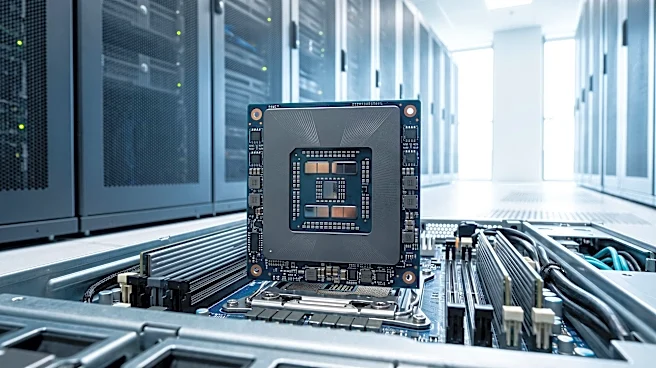
1,809.00 PFlop/s, placing it second globally behind China's LineShine. The supercomputer is powered by AMD 4th Gen EPYC processors and AMD Instinct MI300A accelerators, utilizing HPE's Slingshot-11 network. It operates for the National Nuclear Security Administration (NNSA) and was installed in 2024. El Capitan's performance significantly surpasses other leading supercomputers in the US and Europe, including Frontier at Oak Ridge National Laboratory and Aurora at Argonne National Laboratory, which rank second and third respectively in the region. Its energy efficiency is reported at 60.94 Gigaflops/watt, and it holds the second-highest HPCG benchmark score globally.
Why It's Important?
The designation of El Capitan as the fastest public supercomputer in the US and Europe underscores America's continued leadership in high-performance computing, a critical domain for national security, scientific research, and technological advancement. This achievement is particularly significant in the context of global competition in artificial intelligence and advanced computing capabilities. The supercomputer's immense processing power enables complex simulations and data analysis vital for nuclear deterrence, climate modeling, and materials science, directly supporting the NNSA's mission. Furthermore, the use of AMD processors highlights the competitive landscape within the semiconductor industry, demonstrating AMD's capacity to power top-tier computing infrastructure. This technological edge can attract further investment in US research institutions and foster innovation across various scientific and engineering fields, reinforcing the nation's strategic advantage in critical technologies.
What's Next?
The ongoing operation and utilization of El Capitan will likely lead to breakthroughs in various scientific and national security applications. Researchers and government agencies will leverage its capabilities for advanced simulations, data analytics, and AI model training, potentially accelerating discoveries in fields such as materials science, energy research, and defense. The performance metrics established by El Capitan will also serve as a benchmark for future supercomputer development, driving further innovation in processor technology, network infrastructure, and energy efficiency. As the TOP500 list is updated biannually, the supercomputer community will closely monitor El Capitan's sustained performance and any new contenders that emerge, particularly from other global powers. Continued investment in such high-performance computing resources will be crucial for maintaining the US's competitive edge in the rapidly evolving technological landscape.
Beyond the Headlines
El Capitan's prominence extends beyond its raw processing power, symbolizing the strategic importance of exascale computing in geopolitical competition. The development and deployment of such advanced systems are integral to national security, enabling the US to maintain technological superiority in areas like nuclear weapons stewardship and intelligence gathering. The collaboration between government laboratories and private sector companies like AMD and HPE in building El Capitan also illustrates a successful model for public-private partnerships in critical technology development. This supercomputer represents a significant investment in infrastructure that supports not only immediate scientific and defense objectives but also long-term economic competitiveness by fostering a skilled workforce and driving innovation in related industries. Its capabilities will likely influence the future direction of AI research and development, pushing the boundaries of what is computationally possible and potentially leading to unforeseen technological advancements.