



What's Happening?
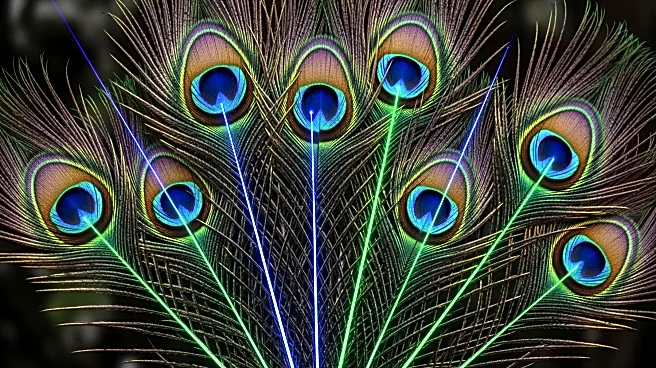
A groundbreaking study has discovered that peacock feathers can emit laser beams when treated with a common dye and excited by a green pulse. Researchers at Florida Polytechnic University found that the feathers, when soaked with rhodamine 6G and subjected
to repeated wetting and drying cycles, produced laser light at specific wavelengths. This phenomenon is attributed to the unique photonic structures within the feathers, which act as resonators. The study suggests potential applications in biological sensing and imaging, leveraging the natural structures found in peacock feathers.
Why It's Important?
The ability of peacock feathers to emit laser beams opens new avenues for exploring biological materials and developing biocompatible light sources. This discovery could lead to advancements in medical imaging and sensing technologies, offering safer and more efficient methods for interacting with living tissues. The research highlights the potential for using natural structures in technological applications, providing insights into the evolutionary processes that have developed complex optical systems in nature.
Beyond the Headlines
The study of peacock feathers emitting laser beams challenges traditional views on biological materials and their capabilities. It underscores the importance of interdisciplinary research in uncovering hidden properties of natural structures. The findings may inspire further exploration into other biological materials that could possess similar optical properties, potentially leading to innovative applications in various fields, including medicine and environmental monitoring.