
What's Happening?
New research published in Science Advances proposes that Earth-like planets may be more common in the universe than previously thought. The study, led by Ryo Sawada from the University of Tokyo, introduces
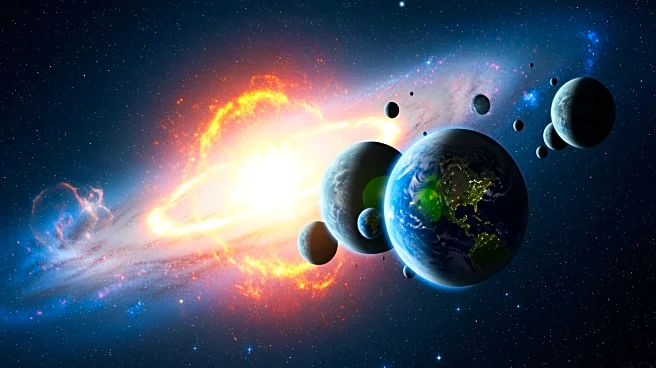
a supernova immersion model that suggests cosmic rays from a nearby supernova contributed to the formation of rocky planets in our solar system. This model posits that the supernova, occurring about 3.2 light-years away, provided the necessary radioactive materials to form dry, rocky worlds. The findings indicate that similar processes could be widespread across the galaxy, potentially increasing the number of habitable planets.
Why It's Important?
The implications of this research are profound for the search for extraterrestrial life. If Earth-like planets are more common, it increases the likelihood of finding habitable worlds beyond our solar system. The study challenges previous models that could not account for the abundance of short-lived radionuclides necessary for planet formation. By providing a new mechanism for their delivery, this research enhances our understanding of planetary formation and the conditions that make planets habitable. It also suggests that a significant percentage of sun-like stars could host planet-forming disks with similar conditions to our solar system.
Beyond the Headlines
The study's findings could reshape our approach to searching for life in the universe. By identifying the conditions under which Earth-like planets form, scientists can better target their search for habitable worlds. This research also highlights the role of cosmic events, such as supernovae, in shaping planetary systems. Understanding these processes could lead to new insights into the history of our solar system and the potential for life elsewhere. The study underscores the interconnectedness of cosmic phenomena and planetary development.