



What's Happening?
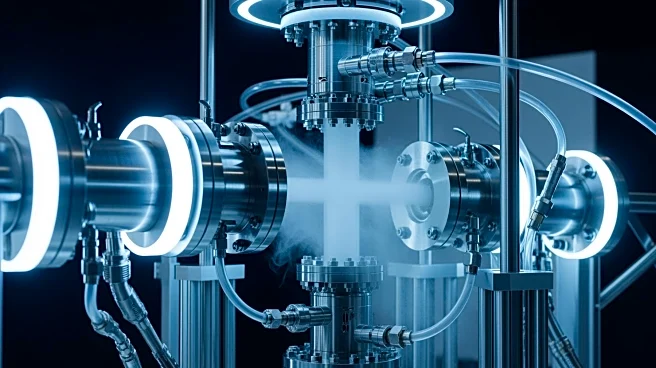
NASA has achieved a significant milestone in advancing nuclear propulsion technology, which could revolutionize future deep space missions. The agency completed a cold-flow test campaign of a flight reactor engineering development unit, marking the first
such testing since the 1960s. Conducted at NASA's Marshall Space Flight Center in Huntsville, Alabama, the tests ran from July through September. The 44-inch by 72-inch unit, developed by BWX Technologies, simulates propellant flow across various operational conditions. This non-nuclear, flight-like test article is crucial for understanding the operational characteristics and fluid flow performance of nuclear reactors. The tests demonstrated that the reactor design is not prone to destructive oscillations or vibrations, which are critical for ensuring the system's stability during space missions.
Why It's Important?
The advancement of nuclear propulsion technology by NASA is pivotal for the future of space exploration. This technology offers multiple benefits, including increased speed and endurance, which are essential for complex deep space missions. By potentially shortening travel times and expanding mission capabilities, nuclear propulsion could enable exploration further into the solar system than ever before. Additionally, it could increase the science payload capacity and provide higher power for instrumentation and communication. These developments are crucial for the U.S. space industry, as they enhance the country's capabilities in space exploration and maintain its leadership in space technology.
What's Next?
Following the successful cold-flow tests, NASA will likely focus on further developing and refining the nuclear propulsion technology to make it flight-capable. This involves continued collaboration with industry partners to validate analytical tools and design the flight instrumentation and control systems. The next steps may include manufacturing, assembly, and integration of near-term flight-capable nuclear propulsion systems. As these technologies progress, they could significantly impact future missions to the Moon, Mars, and beyond, potentially leading to new scientific discoveries and advancements in human spaceflight.