





What's Happening?
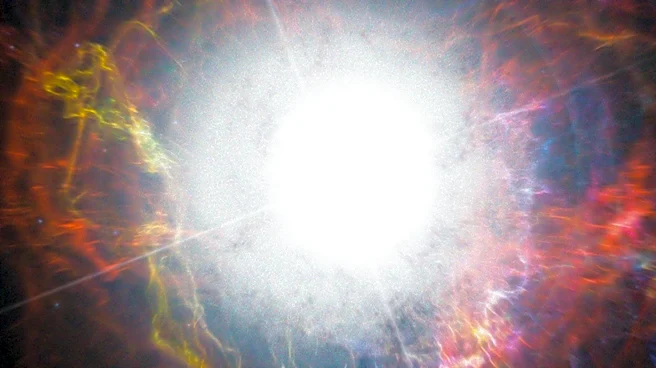
New images from the Gemini North telescope in Hawai'i have revealed intricate chains of gas knots, dubbed 'cosmic pearls,' within the supernova remnant Pa 30. This remnant is associated with a stellar explosion recorded in 1181 CE, approximately 850 years
ago. The observational study, published in The Astrophysical Journal, utilized narrowband filters to highlight gas structures, specifically from singly ionized sulfur and doubly ionized oxygen, which were previously harder to distinguish. These images show that the radial filaments of Pa 30, which were thought to be smooth, are actually composed of cascades of these uniformly sized knots. Each knot measures approximately 100 billion kilometers in diameter, roughly ten times the size of Neptune's orbit. Pa 30 is unique as it is the only known Milky Way remnant of its kind, featuring a surviving hot star at its center, informally referred to as a 'zombie star.' This central star's presence and the characteristics of the remnant support its classification as a Type Iax supernova, a fainter thermonuclear explosion that does not completely destroy its progenitor star. The research team, co-led by Tim Cunningham and Ilaria Caiazzo, found that the central star's position aligns closely with the nebula's geometric center, suggesting a minimal sideways recoil from the explosion.
Why It's Important?
The discovery of these 'cosmic pearls' in Pa 30 provides crucial new data for understanding Type Iax supernovae, a class of stellar explosions that are not fully understood. Pa 30's unique status, being the only known Milky Way remnant of its kind with a surviving central star and resolved ejecta, makes it an invaluable natural laboratory for testing theoretical models of incomplete stellar destruction. The uniform size and arrangement of the gas knots present a new challenge for researchers, as existing models for supernova ejecta and surrounding gas interactions do not fully explain these regular chains. This finding could lead to significant advancements in astrophysics, refining our understanding of stellar evolution, supernova mechanisms, and the formation of complex structures in space. The precise measurement of the central star's minimal recoil also offers important constraints for explosion models, helping scientists to better simulate and predict the outcomes of such cosmic events. Furthermore, Pa 30 serves as a reference point for identifying other similar remnants in our galaxy and beyond, potentially expanding our knowledge of these rare and intriguing stellar phenomena.
What's Next?
Researchers plan to develop new models to explain the formation and uniformity of the 'cosmic pearls' within Pa 30, as current theories do not fully account for these observations. Further observations with advanced telescopes, such as the Hubble Space Telescope, are anticipated to sharpen measurements of the knots and the central star's position, providing more detailed data for analysis. Deeper oxygen observations and sharper imaging could help differentiate between genuinely diffuse gas and numerous faint, individual filaments, which remain unresolved components in the current images. The team also intends to use Pa 30 as a reference to search for other similar supernova remnants in the Milky Way and nearby galaxies, leveraging its unique filament geometry, clumpy structure, and surviving star as key indicators. This ongoing research aims to refine our understanding of Type Iax supernovae and the broader implications for stellar evolution and the dynamics of stellar explosions.
Beyond the Headlines
The intricate structure of Pa 30, with its 'cosmic pearls' and 'zombie star,' highlights the complexity and unexpected beauty of cosmic phenomena. This discovery pushes the boundaries of our understanding of stellar death and rebirth, revealing that even after a violent explosion, remnants can exhibit highly organized and puzzling patterns. The challenge of modeling these uniform knots underscores the limitations of current astrophysical theories and the need for innovative approaches to interpret observational data. The concept of a 'zombie star' surviving an incomplete supernova also raises profound questions about the conditions under which stars can endure such catastrophic events, potentially leading to new insights into the life cycles of stars. This research not only contributes to scientific knowledge but also inspires a deeper appreciation for the universe's intricate processes and the continuous quest to unravel its mysteries.