
What's Happening?
Researchers from the Siberian Branch of the Russian Academy of Sciences, in collaboration with the Limnological Institute, have discovered previously unrecorded mud volcanoes in Lake Baikal, the world's
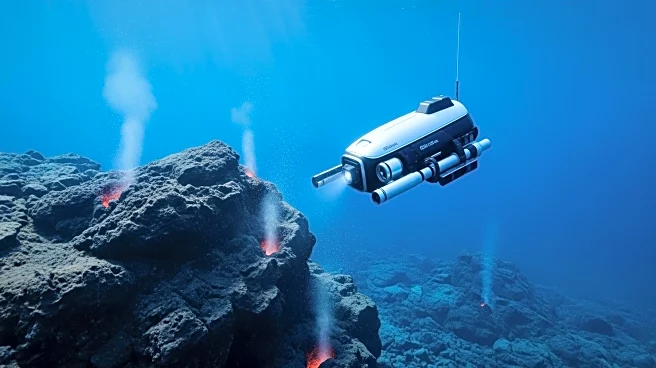
deepest and oldest freshwater lake. Using unmanned underwater vehicles, the team identified geological formations at depths between 120 and 165 meters in the lake's northwestern basin. These formations, including cone-shaped mounds and crater depressions, are linked to the Severobaikalsk fault, a known seismic structure. The findings suggest that small underground displacements are enabling gas-charged fluids and clay-rich sediments to breach the surface, indicating active geological processes closer to the lake margins than previously thought.
Why It's Important?
The discovery of mud volcanoes in Lake Baikal has significant implications for understanding regional geodynamics and seismic activity. The Severobaikalsk fault, associated with notable seismic events, appears to be active, as evidenced by the alignment of mud volcanoes along its trend. This suggests ongoing fluid migration and subsurface material venting, which can act as pressure release mechanisms. These processes may reduce seismic buildup in some areas but also highlight a live tectonic system adjusting to crustal extension in the Baikal rift zone. The findings underscore the importance of continued monitoring and incorporating these features into regional tectonic models to refine hazard assessments.
What's Next?
Researchers emphasize the need for ongoing seismic monitoring and further exploration of Lake Baikal's geological features. The formation of new surface structures associated with gas release can serve as indicators of subsurface stress, potentially refining hazard assessments for surrounding areas. The presence of extremophiles in the volcanic craters also opens avenues for studying life in extreme environments, with implications for astrobiology. Continued research may provide insights into the lake's tectonic dynamics and contribute to broader scientific understanding of rift settings and their associated ecosystems.
Beyond the Headlines
The discovery of mud volcanoes in Lake Baikal not only highlights geological activity but also supports active ecosystems. Invertebrates and microbial life observed in the volcanic craters add a biological layer to the findings, offering models for studying life in extreme environments. These conditions may have implications for astrobiology, particularly in understanding subsurface oceans on moons like Europa and Enceladus. The research also contributes to international scientific communities' interest in methane-rich habitats as analogues for extraterrestrial biospheres.