





What's Happening?
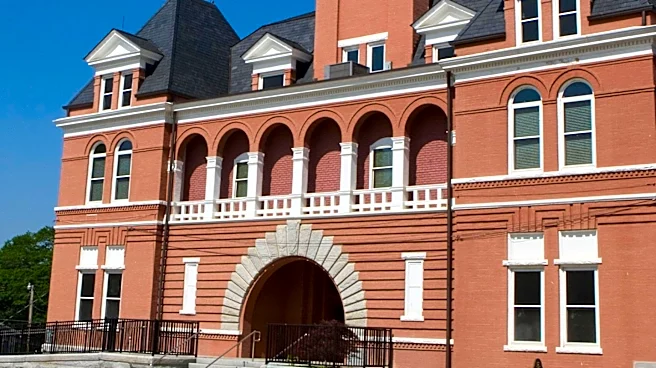
The Denton County Courthouse in Denton, Texas, has a rich history marked by several architectural phases and reconstructions. The first brick courthouse, built in 1877, was a two-story Victorian and Italianate structure featuring tall arched windows,
a decorative cornice, projecting wings, and a central cupola. This building, costing $40,000, began to show significant wear by 1890, with crumbling plaster ceilings and worsening wall cracks. After being struck by lightning and declared unsafe by the grand jury in 1894, it was demolished in 1895. Construction then began on the current courthouse. Fifteen architects were initially considered for the new design, with James Riley Gordon briefly hired before being dismissed. Ultimately, W.C. Dodson was chosen as the architect, pushing for a Romanesque design that incorporated elements of Second Empire, Romanesque Revival, and Italianate styles. The current courthouse, completed in 1896, is distinguished by its corner balconies, polished red granite columns, and intricate carved-stone details. It was recognized as a Recorded Texas Historic Landmark in 1970 and listed in the National Register of Historic Places in 1977, undergoing several restoration phases, with a rededication in 2004 to honor its original design.
Why It's Important?
The evolution of the Denton County Courthouse reflects broader trends in 19th-century American public architecture and the growth of county governments. The initial 1877 structure, one of Denton's first brick buildings, symbolized the county's early development and aspirations, showcasing popular Victorian and Italianate styles. Its subsequent deterioration and replacement highlight the challenges of maintaining public infrastructure and the continuous need for modernization. The selection of W.C. Dodson and his Romanesque design for the current courthouse underscores the architectural preferences of the era, emphasizing grandeur and civic importance. The courthouse's designation as a Recorded Texas Historic Landmark and its inclusion in the National Register of Historic Places signify its cultural and historical value, preserving a tangible link to the region's past. The extensive restoration efforts, culminating in the 2004 rededication, demonstrate a commitment to historical preservation and ensuring that public buildings continue to serve as functional and symbolic centers for their communities, influencing local identity and civic pride.
What's Next?
The Denton County Courthouse continues to serve as a functional government building and a historical landmark. Visitors are welcome to explore the building during open hours, Monday through Friday, from 8:00 AM to 4:30 PM. The museum gallery on the first floor is open Monday through Friday from 10:00 AM to 4:00 PM and on Saturdays from 11:00 AM to 3:00 PM. Ongoing maintenance and preservation efforts will likely continue to ensure the structural integrity and historical accuracy of the building. The courthouse's role as a public space for both government operations and historical education will remain central to its function. Future initiatives might include further educational programs or exhibits to engage the public with its rich history and architectural significance. The continued accessibility to the public ensures that its legacy as a symbol of Denton County's heritage endures for future generations.
Beyond the Headlines
The architectural journey of the Denton County Courthouse offers a deeper insight into the interplay between civic ambition, technological limitations, and evolving aesthetic tastes in the late 19th century. The rapid deterioration of the 1877 brick structure, despite its initial grandeur, illustrates the challenges of construction materials and techniques of the time. The subsequent decision to rebuild, rather than merely repair, speaks to a desire for permanence and a grander civic statement, reflecting the growing prosperity and self-image of Denton County. The shift in architectural styles from Victorian/Italianate to Romanesque Revival also mirrors broader national trends in public building design, where Romanesque was often chosen for its perceived strength and dignity. The uncredited labor of artisans and builders, whose skills brought these designs to life, often goes unnoticed, yet their craftsmanship is integral to the building's enduring appeal. The courthouse stands not just as a building, but as a testament to the community's continuous effort to define and represent itself through its public spaces, embodying a blend of historical continuity and adaptive change.