






What's Happening?
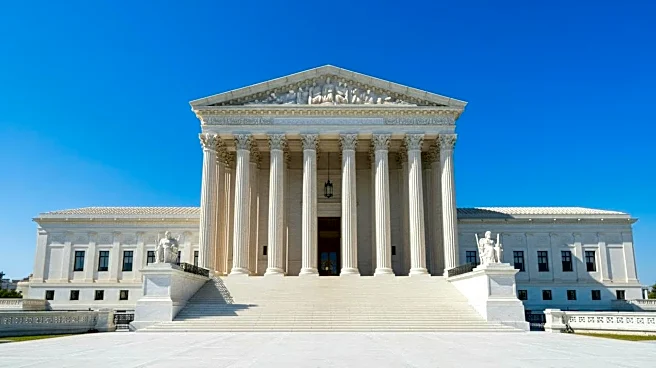
Congressional Democrats are actively pursuing significant structural reforms to the Supreme Court, driven by concerns over its conservative majority and a series of rulings on voting rights, campaign finance, abortion, and presidential power. Proposed
legislation includes expanding the court from nine to 13 justices, implementing 18-year term limits for justices, establishing a binding ethics code, and curbing the court's use of the "shadow docket." This push comes amidst historically low public approval ratings for the Supreme Court. Republicans and conservative legal advocates view these efforts as an attempt to punish the court for decisions unfavorable to the left and to pressure justices, rather than addressing genuine legal flaws. They argue that such proposals could further politicize the judiciary.
Why It's Important?
The proposed reforms highlight a growing partisan divide regarding the role and composition of the Supreme Court, a critical institution in the U.S. system of checks and balances. If enacted, changes like court expansion or term limits could fundamentally alter the ideological balance of the court, influencing future legal interpretations and policy outcomes for decades. A binding ethics code could increase accountability and transparency, potentially restoring public trust, but could also be seen as an overreach into judicial independence. The debate over the "shadow docket" addresses concerns about the court making significant decisions without full oral arguments or transparency. The outcome of this legislative push could redefine the judiciary's power and its relationship with the legislative and executive branches, impacting civil liberties, electoral processes, and the balance of power in American governance.
What's Next?
While Democrats are pushing these reforms with urgency, the likelihood of their passage is considered low unless the party secures firm control of Congress and eliminates the filibuster, a scenario deemed highly improbable. Republicans are staunchly opposed, viewing the proposals as politically motivated. Legal scholars are also weighing in, with some warning that certain reforms could exacerbate the politicization of the court. Alternative ideas, such as a "balanced bench" with an equal number of justices chosen by Democrats and Republicans, are also being discussed. The ongoing debate is expected to continue, with both sides advocating for their positions, but without significant shifts in the political landscape, these proposals may remain legislative aspirations rather than immediate realities. The discussion itself, however, underscores persistent tensions surrounding the judiciary's role and perceived impartiality.
Beyond the Headlines
The push for Supreme Court reform reflects a deeper societal struggle over the interpretation of the U.S. Constitution and the balance of power among governmental branches. The perception of the court as increasingly politicized, rather than a neutral arbiter of law, erodes public trust in democratic institutions. This erosion can have long-term consequences for the legitimacy of judicial decisions and the stability of the legal framework. The debate also touches upon the fundamental principles of judicial independence versus accountability. If the court is seen as merely an extension of political power, its ability to uphold the rule of law impartially could be compromised, leading to increased social and political polarization. The discussion around these reforms is not just about specific legislative changes but about the very nature of American democracy and the future of its foundational institutions.