



What's Happening?
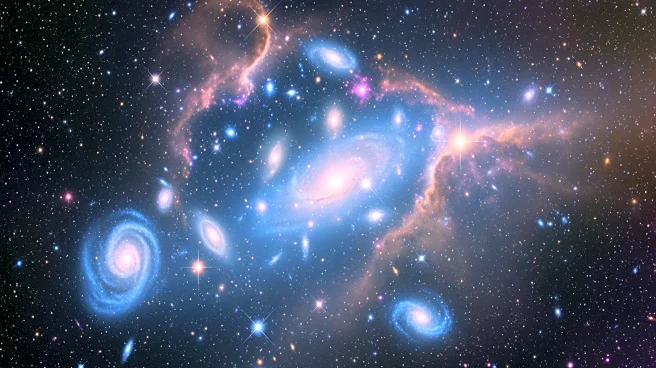
The James Webb Space Telescope has successfully captured detailed images of two dwarf galaxies, NGC 4490 and NGC 4485, which are located approximately 24 million light-years away in the constellation Canes Venatici. This achievement is credited to the collaborative
efforts of the European Space Agency (ESA), NASA, and the Canadian Space Agency (CSA), along with contributions from researchers at Stockholm University and the FEAST JWST team. The images provide a remarkable view of these galaxies, showcasing the advanced capabilities of the James Webb Space Telescope in observing distant celestial bodies.
Why It's Important?
The capture of these images by the James Webb Space Telescope is significant for several reasons. Firstly, it demonstrates the telescope's advanced technological capabilities in observing and capturing high-resolution images of distant galaxies, which can provide valuable insights into the formation and evolution of galaxies. This achievement also highlights the successful international collaboration between space agencies and research institutions, which is crucial for advancing our understanding of the universe. The data obtained from these observations can contribute to scientific research and potentially lead to new discoveries in astrophysics.