




What's Happening?
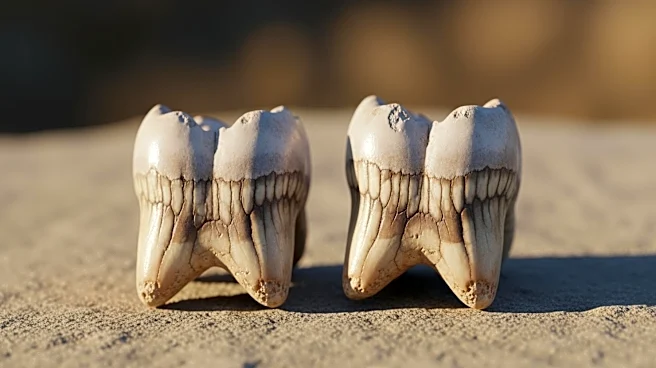
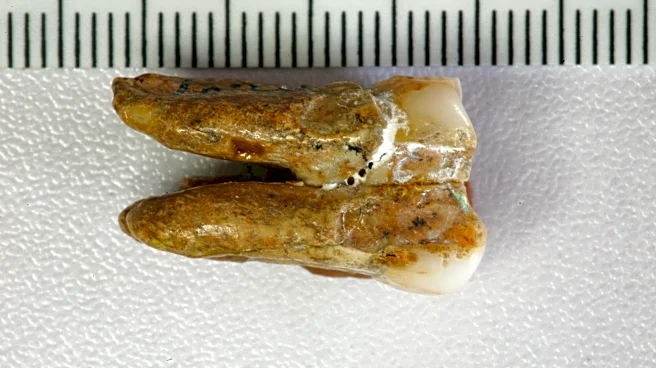
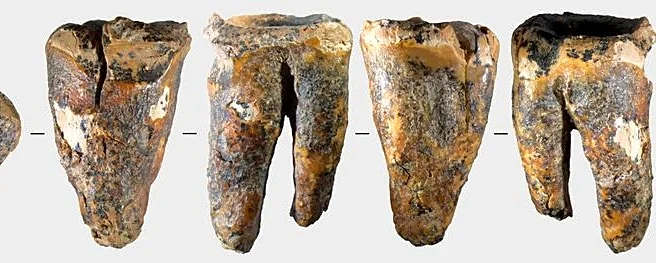
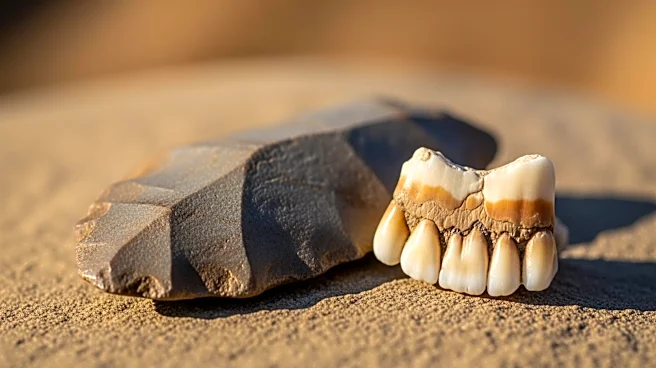
Researchers have unearthed 400,000-year-old teeth in China, revealing new insights into human evolution. The study, published in the journal Nature, highlights the extraction of ancient proteins from these teeth, which are linked to early human ancestors.
The findings suggest interactions between Homo erectus and later human relatives, including Denisovans, through shared genetic markers. This discovery challenges the linear view of human evolution, proposing a complex web of connections. The research utilized a non-destructive acid-etching technique to extract proteins, preserving the integrity of the fossils.
Why It's Important?
This discovery is significant as it expands the timeline of ancient human molecules by hundreds of thousands of years, providing a deeper understanding of human ancestry. The identification of genetic markers shared with Denisovans suggests interbreeding and genetic exchange among ancient human populations. This challenges traditional views of human evolution and highlights the complexity of our evolutionary history. The findings could lead to a reevaluation of the relationships between different human species and contribute to the broader understanding of human migration and adaptation.
What's Next?
Future research will likely focus on further analyzing these genetic markers to understand their implications for human evolution. Scientists may explore other fossil sites to identify similar genetic markers, potentially uncovering more about the interactions between ancient human populations. The development of non-destructive techniques for protein extraction could also be applied to other archaeological finds, enhancing the study of ancient human history. This research may prompt a reexamination of existing fossil collections, leading to new discoveries and insights into the evolutionary connections between early human species.