
What's Happening?
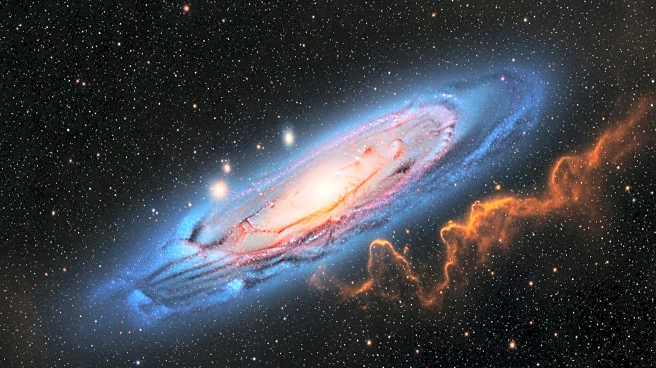
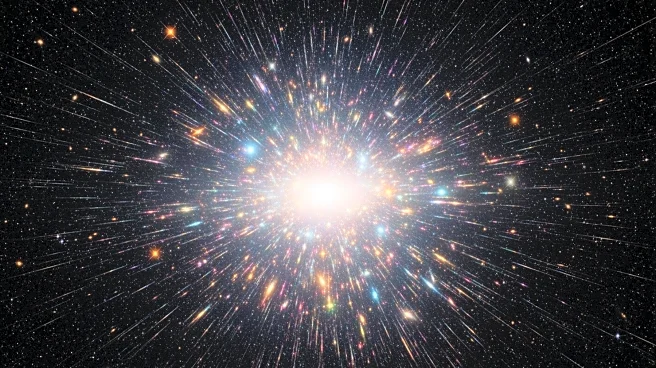
A cosmic explosion, identified as GRB 250702B, has been recorded as the longest gamma-ray burst observed, lasting nearly seven hours. Detected in a distant, dusty galaxy, the event does not fit existing
models for gamma-ray bursts, which typically last much shorter durations. The explosion's origin is uncertain, with potential causes including a massive star collapse, a stellar collision, or a tidal disruption by a black hole. This event provides new insights into extreme cosmic environments and the distribution of elements in the universe.
Why It's Important?
This gamma-ray burst challenges current understanding of such cosmic events, prompting a reevaluation of existing models. Understanding these bursts is crucial for astrophysics, as they offer insights into the universe's most energetic phenomena and the conditions that produce them. The findings could lead to revisions in theories about gamma-ray bursts and improve knowledge of the universe's structure and evolution. Additionally, these events play a role in dispersing heavy elements, essential for life, across the cosmos.
What's Next?
Astronomers will continue to study GRB 250702B to determine its exact cause and characteristics. This event will serve as a benchmark for future gamma-ray burst observations, helping scientists identify whether similar events match its properties or represent new phenomena. Ongoing research will focus on gathering more data and refining models to better understand these powerful cosmic explosions.