
What's Happening?
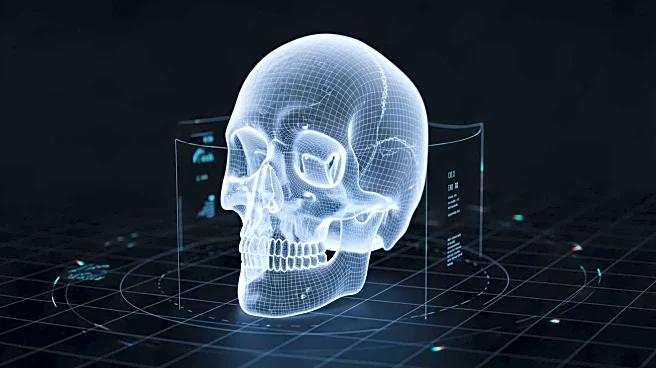
An international research team led by Dr. Karen Baab has digitally reconstructed the face of an early Homo erectus fossil, known as DAN5, discovered in Ethiopia's Afar region. The fossil, dated to about
1.5 to 1.6 million years ago, presents a more archaic facial structure than previously expected. This reconstruction, published in Nature Communications, combines a fossil brain case with smaller facial fragments using high-resolution micro-CT scans. The study suggests that the Gona population, where the fossil was found, retained anatomical features from populations that migrated out of Africa approximately 300,000 years earlier. The Gona area is notable for its deep record of hominin fossils and stone tools, providing significant insights into early human evolution.
Why It's Important?
This discovery is significant as it challenges existing theories about the evolution and migration of Homo erectus. The reconstructed face of DAN5, with its mix of Homo erectus traits and older features, suggests a more complex evolutionary history than previously understood. It highlights the anatomical diversity within early human species and supports the idea of an African origin for Homo erectus. The findings could reshape our understanding of human evolution, particularly regarding the migration patterns and adaptation strategies of early humans. This research underscores the importance of fossil records in piecing together human history and evolution.
What's Next?
Researchers plan to compare the DAN5 fossil with early human fossils from Europe, such as Homo antecessor, to further understand facial variability within Homo erectus. This comparison could provide insights into how the species adapted and evolved across different regions. The team also hopes to explore possibilities of genetic admixture between species, similar to later interactions among Neanderthals, modern humans, and Denisovans. Future discoveries of fossils dated between one to two million years ago are anticipated to help clarify these evolutionary relationships.