






What's Happening?
NASA scientists recently traveled to the Scottish Highlands to investigate rock formations that offer clues about Mars' ancient past. The Stoer formation in Scotland provides a unique environment where rocks, formed in conditions similar to ancient Martian
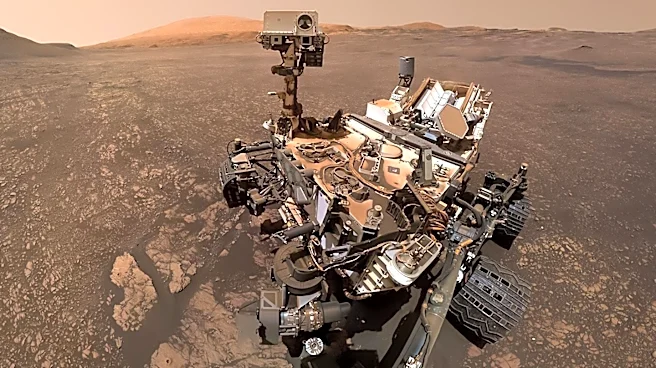
lakes and rivers, also contain evidence of microbial life from 1.2 billion years ago, predating land plants. This makes the location an ideal planetary analog for interpreting data from NASA's Mars rovers. The Goddard Instrument Field Team, based at NASA's Goddard Space Flight Center, conducted expeditions along the coasts and cliffs of the Clachtoll region. They used handheld instruments to analyze mineral and chemical compositions, searched for environmental clues, and collected samples for further laboratory analysis. The research was prompted by the Perseverance rover's discovery of reduction spots in Mars' Jezero Crater, which are chemical reaction signs that could indicate ancient microbial life. The team's work aims to enhance understanding of Martian data, aid in planning future rover investigations, and prepare the scientific community for potential Martian sample analysis.
Why It's Important?
This field research in the Scottish Highlands is critical for advancing our understanding of Mars' potential for past life and habitability. By studying Earth-based geological formations that mimic ancient Martian environments, scientists can develop more accurate methods for identifying biosignatures on the Red Planet. The presence of ancient microbial life in the Scottish rocks, formed under conditions similar to early Mars, provides a valuable comparative model. This research directly supports NASA's Mars exploration program, helping to refine the interpretation of data sent back by rovers like Perseverance. It also informs the design and objectives of future missions, ensuring that instruments and methodologies are optimized for detecting subtle signs of life. The interdisciplinary collaboration involved, including various universities and NASA centers, highlights the complex and multifaceted approach required for planetary science, ultimately contributing to humanity's quest to answer fundamental questions about life beyond Earth.
What's Next?
The collected rock samples from the Scottish Highlands are now undergoing deeper analysis in laboratories across the United States and internationally. This analysis will focus on the chemical and mineral traces of ancient life preserved within the Stoer rocks, providing detailed insights that cannot be obtained in the field. The findings from this research will be used to refine the interpretation of data from NASA's Mars rovers, particularly regarding the reduction spots found in Jezero Crater. This will help mission teams plan new rover investigations, potentially guiding where future rovers should explore and what types of samples they should prioritize. Furthermore, this work is preparing the scientific community for the eventual analysis of Martian samples that may be returned to Earth by future missions, ensuring that the necessary expertise and analytical tools are in place. The ongoing collaboration among various institutions will continue to foster advancements in planetary analog research and astrobiology.
Beyond the Headlines
The study of planetary analogs, such as the Scottish Highlands, offers a profound ethical and philosophical dimension to space exploration. By understanding how life leaves its traces in extreme or ancient environments on Earth, scientists are better equipped to recognize similar patterns on other celestial bodies, thereby informing the search for extraterrestrial life. This research also highlights the interconnectedness of Earth's geological and biological history with that of other planets, suggesting universal principles governing planetary evolution and the emergence of life. The meticulous process of identifying and interpreting biosignatures on Earth, even in seemingly barren landscapes, underscores the complexity of defining and detecting life beyond our planet. This work not only pushes the boundaries of scientific knowledge but also encourages a broader perspective on humanity's place in the cosmos and the potential for life to exist in diverse forms across the universe, challenging anthropocentric views of life.