
What's Happening?
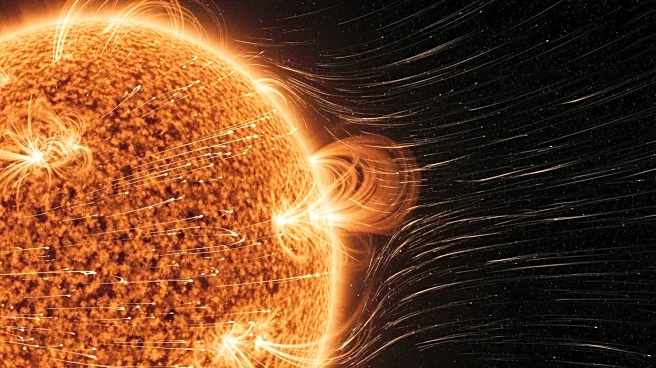
NASA's Parker Solar Probe has successfully created the first continuous, two-dimensional maps of the Sun's outer atmosphere boundary, known as the Alfvén surface. This boundary is crucial as it marks the point
where solar material escapes the Sun's magnetic field to become solar wind, a high-speed stream of particles that travels across the solar system. The findings, published in the Astrophysical Journal Letters, reveal that the Alfvén surface becomes larger, rougher, and spikier as the Sun enters more active phases of its 11-year solar cycle. The Parker Solar Probe, which flies closer to the Sun than any other spacecraft, has provided direct measurements of this boundary, offering new insights into its structure and behavior.
Why It's Important?
Understanding the Alfvén surface is vital for comprehending the dynamics of the Sun's outer atmosphere, or corona, and its influence on the solar system. The solar wind, originating from this boundary, affects planets, spacecraft, and technological systems on Earth. By mapping this boundary, scientists can better predict solar activity and its potential impacts on Earth, such as geomagnetic storms that can disrupt communications and power grids. The Parker Solar Probe's findings enhance our knowledge of solar physics and contribute to safeguarding technology and infrastructure from solar-induced disruptions.
What's Next?
Future missions and continued observations by the Parker Solar Probe and other solar observatories like the NASA/ESA Solar Orbiter will further refine our understanding of the Alfvén surface. These efforts aim to improve predictive models of solar activity and its effects on the solar system. As the Sun progresses through its solar cycle, ongoing research will focus on how changes in solar activity influence the Alfvén surface and the solar wind, providing critical data for space weather forecasting.