






What's Happening?
Roger Pielke Jr., a senior fellow at the American Enterprise Institute and Substack writer, recently discussed the evolution of climate science communication and policy in an interview with Darren Samuelsohn. Pielke highlighted the launch of his new 'THB
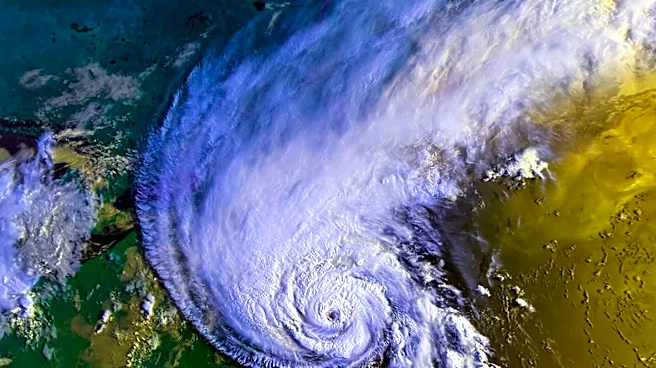
Extreme Weather and Climate Change Dashboard,' which compiles official U.S. government data on extreme weather events. This initiative was partly motivated by the President Trump administration's removal of some climate data online, aiming to provide a single, accessible source for trends in floods, hurricanes, droughts, and other phenomena. Pielke asserts that the dashboard's findings align perfectly with the Intergovernmental Panel on Climate Change (IPCC) working group one conclusions, suggesting that many claims about worsening extreme weather are often sensationalized or based on single studies rather than comprehensive data. He also noted the significant role of artificial intelligence, specifically Claude, in rapidly developing this data dashboard, a task that would have previously taken years and a team of researchers. Pielke emphasized that his work, which focuses on the nuances of climate science, has often been met with resistance due to its divergence from prevailing narratives, particularly since 2006 when extreme weather became a central focus of climate change advocacy.
Why It's Important?
Pielke Jr.'s work is significant for several reasons, primarily for its challenge to the often-simplified public discourse surrounding climate change and extreme weather. By providing a data-driven dashboard, he aims to empower journalists and policymakers with accessible, official information, thereby fostering a more informed discussion. This initiative is crucial in an era where climate science is frequently instrumentalized for political advantage, leading to what Pielke describes as a 'poisonous' partisan environment. His perspective highlights how the focus on climate policy has, in his view, failed to accelerate decarbonization rates, suggesting that a shift back to a broader 'energy policy' umbrella, encompassing affordability and growth alongside emissions reduction, might be more effective. The discussion underscores the impact of political polarization on scientific communication, where nuanced findings are often dismissed if they do not align with established narratives, affecting public understanding and policy formulation. The accessibility of comprehensive data could help stakeholders make more evidence-based decisions, potentially shifting the focus from partisan rhetoric to practical solutions.
What's Next?
The availability of Roger Pielke Jr.'s Extreme Weather and Climate Change Dashboard could influence future discussions by providing a centralized, official data source for U.S. extreme weather trends. This resource may encourage a more data-informed approach to climate and energy policy, potentially challenging existing narratives that Pielke argues are often sensationalized. Pielke anticipates a continued shift in focus from 'climate policy' as the overarching framework to 'energy policy,' driven by increasing electricity demand from sectors like data centers and the electrification of transportation. This reorientation could lead to policy debates that prioritize energy affordability, expansion, and emissions reduction concurrently, rather than solely focusing on emissions. However, Pielke also acknowledges the ongoing challenge of communicating scientific nuance in a media landscape that often favors hype and partisanship. The reception of his dashboard by media and policymakers will indicate the willingness of various stakeholders to engage with a more complex, data-driven understanding of climate and energy issues, potentially leading to a re-evaluation of current policy approaches.
Beyond the Headlines
Beyond the immediate policy implications, Pielke Jr.'s experience highlights a broader transformation in academic and journalistic landscapes. His move to Substack, an independent platform, allowed him to bypass institutional pressures and reach a vast, diverse audience directly, demonstrating a new model for scholarly communication. This shift underscores the ethical and professional challenges faced by academics whose research may be deemed 'inconvenient' to dominant narratives, leading to professional repercussions as Pielke described from his time in academia. The integration of advanced AI tools like Claude into his research process also signals a significant long-term shift in how scientific data can be analyzed and presented, making complex information more accessible and accelerating research output. Furthermore, Pielke draws parallels between the politicization of climate science and other highly polarized topics, such as 'gender wars in elite sport,' suggesting a systemic issue where nuance is lost in favor of partisan alignment. This indicates a deeper cultural challenge in fostering informed public discourse across various complex issues, where the pursuit of truth often clashes with political expediency.