
What's Happening?
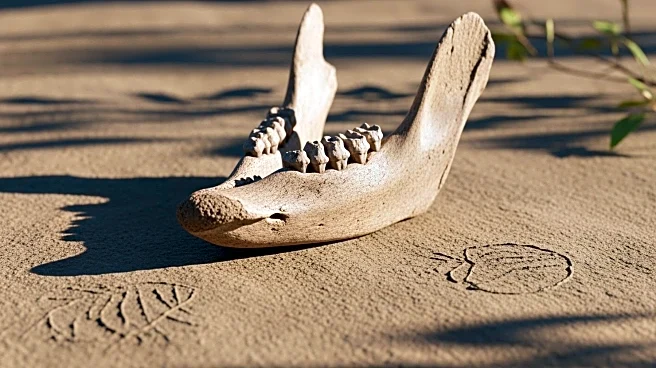
A 2.6 million-year-old fossil jaw discovered in northeastern Ethiopia is reshaping the understanding of early human evolution. The jaw, belonging to the genus Paranthropus, was found over 620 miles north of any
previously discovered fossils of its kind. This discovery suggests that Paranthropus, an extinct relative of humans known for its massive teeth and jaws, had a broader geographical range than previously thought. The fossil was unearthed in the Afar region, an area rich in hominin fossils, yet previously devoid of Paranthropus remains. This finding indicates that Paranthropus could exploit diverse habitats, similar to other hominins like Australopithecus and early Homo species.
Why It's Important?
The discovery of the Paranthropus jaw in Ethiopia provides new insights into the adaptability and distribution of early hominins. It challenges the previous assumption that Paranthropus did not inhabit the northern regions of Ethiopia. This finding could lead to a reevaluation of the evolutionary pathways and interactions among different hominin species. Understanding the distribution and adaptability of Paranthropus can offer clues about the environmental and ecological conditions that shaped human evolution. It also highlights the complexity of human ancestry, suggesting that multiple hominin species coexisted and possibly interacted over millions of years.
What's Next?
The discovery opens new avenues for research into the evolutionary history of hominins. Scientists may conduct further excavations in the Afar region to uncover more Paranthropus fossils, which could provide additional evidence of their presence and adaptation strategies. Researchers might also explore genetic studies to understand the evolutionary relationships between Paranthropus and other hominins. This could lead to new hypotheses about the migration patterns and survival strategies of early human ancestors. The findings may also prompt a reexamination of existing fossil collections to identify overlooked Paranthropus specimens.