







What's Happening?
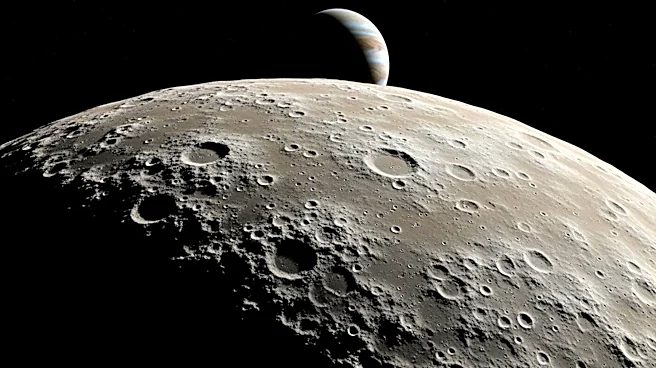
NASA's Juno spacecraft has captured detailed images of Thebe, one of Jupiter's inner moons, during a close flyby on May 1, 2026. The images were taken by the spacecraft's Stellar Reference Unit (SRU) from a distance of approximately 3,100 miles, providing
a resolution of about 1.9 miles per pixel. Thebe is located at the outer edge of Jupiter's faint ring system and is believed to contribute to the formation of the planet's 'gossamer' ring through the shedding of dust. The SRU, primarily used for navigation by imaging star fields, has proven to be a valuable scientific tool due to its high sensitivity in low-light conditions. Managed by the Jet Propulsion Laboratory, the Juno mission is part of NASA's New Frontiers Program, which aims to explore the solar system's outer planets.
Why It's Important?
The images of Thebe captured by Juno provide valuable insights into the composition and behavior of Jupiter's moons and ring system. Understanding these celestial bodies helps scientists learn more about the formation and evolution of the solar system. The data collected by Juno can also enhance our knowledge of planetary rings and their interactions with moons, which is crucial for future space exploration missions. Additionally, the success of the Juno mission demonstrates the effectiveness of using advanced imaging technology in space exploration, potentially paving the way for more detailed studies of other planetary systems.