
What's Happening?
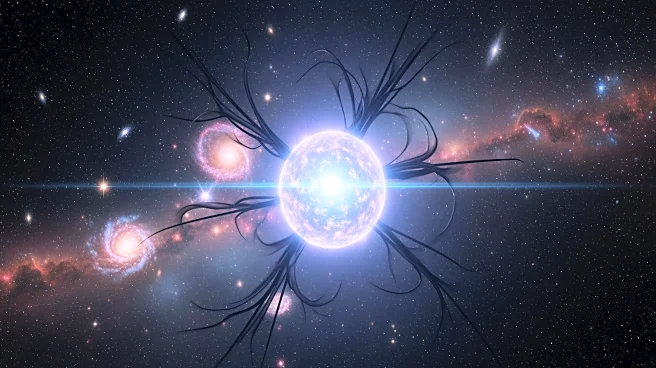
Recent observations from the James Webb Space Telescope have led scientists to identify three unusual objects that may be 'dark stars,' a concept that could significantly alter the understanding of the universe's
early history. These objects, discovered in 2025, are not typical stars; they emit light not from nuclear fusion but from energy released by dark matter. Dark matter, which makes up about 27% of the universe, is not directly observable and does not emit light. The concept of dark stars suggests that dark matter could have played an active role in the early universe, potentially preventing gas clouds from collapsing completely and forming stars that shine with dark matter energy. These stars are believed to be extremely large and ancient, with a strong redshift indicating their light is shifted into infrared wavelengths due to the universe's expansion.
Why It's Important?
The discovery of potential dark stars is significant as it challenges existing theories about the formation of the first stars in the universe. If confirmed, dark stars could provide new insights into the role of dark matter in cosmic evolution, suggesting it was not merely a passive element but an active participant in star formation. This could lead to a reevaluation of the early universe's history and the processes that led to the formation of galaxies and other cosmic structures. The findings could also impact the scientific community's understanding of dark matter, a mysterious component of the universe that remains largely unexplained. The potential existence of dark stars highlights the need for further observations and theoretical developments to fully understand these phenomena.
What's Next?
Further observations and improved theoretical models are necessary to confirm the existence of dark stars and understand their properties. Scientists will likely continue to analyze data from the James Webb Space Telescope and other astronomical instruments to gather more evidence. The scientific community may also engage in debates and discussions to explore alternative explanations for these observations, such as the possibility that the objects are unusual galaxies or massive normal stars. The ongoing research could lead to new discoveries about dark matter and its role in the universe, potentially influencing future space missions and the development of new technologies for observing distant cosmic phenomena.
Beyond the Headlines
The potential discovery of dark stars raises intriguing questions about the nature of dark matter and its interactions with normal matter. It challenges the traditional view of star formation and suggests that dark matter could have a more complex role in the universe than previously thought. This could lead to new theoretical frameworks and models that incorporate dark matter as an active component in cosmic evolution. Additionally, the study of dark stars could provide insights into the conditions of the early universe, offering clues about the processes that led to the formation of galaxies and other large-scale structures. The findings may also have implications for understanding the universe's expansion and the distribution of matter across cosmic scales.