




What's Happening?
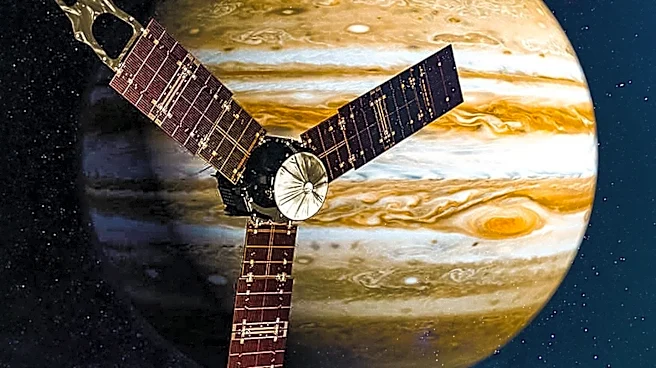
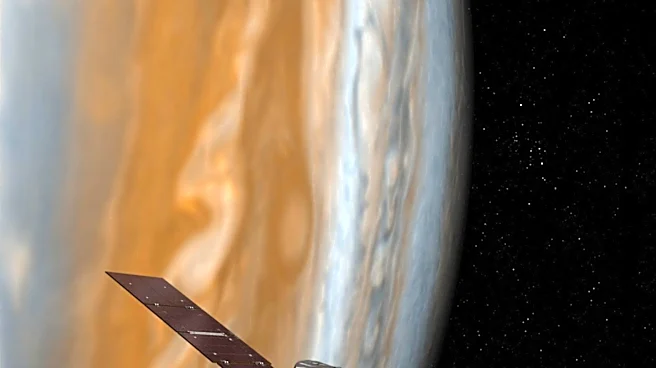
NASA's Juno spacecraft has provided groundbreaking insights into the subsurface heat dynamics of Io, Jupiter's most volcanically active moon. During close flybys in late 2023 and early 2024, Juno used its Microwave Radiometer (MWR) to probe beneath Io's
surface, revealing how heat moves through the moon's crust. This technique, originally intended to study Jupiter's clouds, has now offered a new method to understand volcanic activity. The data showed significant temperature increases just below the surface, suggesting heat movement from Io's molten interior. These findings are crucial as they offer the first glimpse into the internal heat processes of Io, which is continuously heated by Jupiter's gravitational pull, leading to its intense volcanic activity.
Why It's Important?
The insights from Juno's observations are significant for several reasons. Understanding Io's heat dynamics provides a natural laboratory for studying volcanic processes, which can enhance our knowledge of similar phenomena on Earth and other celestial bodies. The ability to measure subsurface temperatures could improve volcanic monitoring and eruption forecasting on Earth. Additionally, the study of Io's heat movement offers clues about tidal heating, a process that could affect other moons in the solar system, potentially influencing their geological activity and habitability. This research could also aid in the search for life by applying similar techniques to probe beneath icy surfaces of moons like Europa and Ganymede, where subsurface oceans may exist.
What's Next?
Future missions and studies may focus on applying the microwave radiometry technique to other celestial bodies, enhancing our understanding of their geological processes. Researchers might also explore the potential of using this method to monitor Earth's volcanoes more effectively. The findings could lead to new missions targeting moons with subsurface oceans, aiming to assess their potential for supporting life. Continued analysis of Juno's data will likely refine our understanding of Io's volcanic activity and its implications for planetary science.
Beyond the Headlines
The study of Io's heat dynamics not only advances our understanding of volcanic processes but also highlights the broader implications of tidal heating in the cosmos. This process, which fuels Io's volcanic activity, could also sustain subsurface oceans on other moons, offering potential habitats for life. The research underscores the interconnectedness of planetary processes and the importance of studying extreme environments to gain insights into more familiar ones. As scientists continue to explore these dynamics, they may uncover new aspects of planetary evolution and habitability.