
What's Happening?
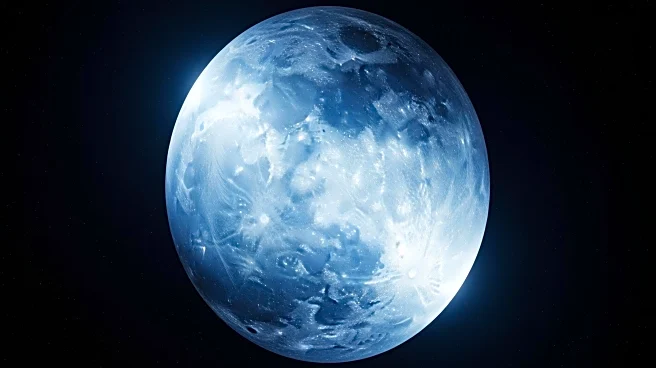
Recent research led by NASA has challenged previous assumptions about Saturn's largest moon, Titan, suggesting that it may not contain a massive ocean beneath its icy surface. Instead, the study indicates
that Titan's interior is likely composed of layers of ice transitioning into slushy pathways and isolated pockets of liquid water. This conclusion was drawn from a reanalysis of data collected by NASA's Cassini mission, which initially proposed the existence of a deep ocean. The new findings, published in Nature, suggest that Titan's interior is more akin to Arctic sea ice or aquifers, which has implications for the potential types of life that might exist there. The study involved contributions from researchers at the University of Washington and NASA's Jet Propulsion Laboratory.
Why It's Important?
The findings have significant implications for the search for extraterrestrial life and our understanding of icy worlds. The presence of slushy layers rather than a vast ocean could mean that any potential life forms on Titan might resemble those found in Earth's polar regions. The study also suggests that Titan's freshwater pockets could reach temperatures conducive to life, with nutrients more concentrated than in a large ocean. This could potentially increase the chances of finding simple life forms. The research also informs NASA's upcoming Dragonfly mission to Titan, scheduled for launch in 2028, which aims to further explore the moon's surface and subsurface conditions.
What's Next?
The new insights into Titan's interior will guide future missions and research, particularly the Dragonfly mission, which will investigate Titan's surface and atmospheric conditions. The mission aims to provide more data on the moon's potential habitability and the presence of life. Researchers will continue to refine their models of Titan's interior and explore the implications of these findings for other icy bodies in the solar system. The study also highlights the need for continued exploration and analysis of data from past missions to enhance our understanding of planetary environments.