








What's Happening?
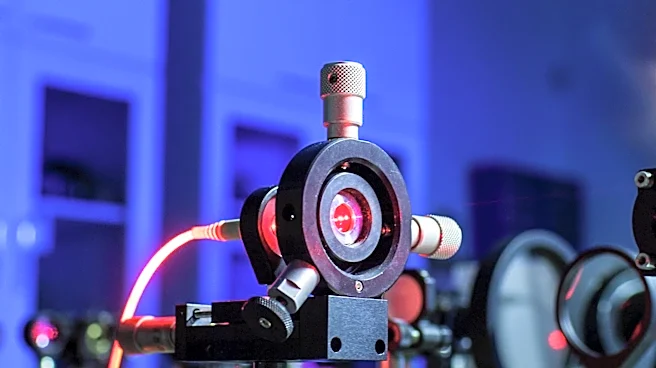
Jonathan Zuegel, a researcher supported by the U.S. National Science Foundation (NSF), is discussing the future of high-powered laser research in the United States. His focus is on the ambitious NSF Optical Parametric Amplifier Line (NSF OPAL) laser facility.
This facility is specifically designed to provide researchers with unprecedented capabilities to explore open questions at the frontiers of science. The NSF OPAL project aims to push the boundaries of scientific inquiry by offering advanced tools for experimentation and discovery in various fields. This initiative highlights the NSF's commitment to fostering cutting-edge research and technological advancements within the U.S. scientific community. The discussion emphasizes the strategic importance of such facilities for maintaining the nation's leadership in scientific innovation and addressing complex scientific challenges.
Why It's Important?
The development and utilization of facilities like NSF OPAL are crucial for the U.S. to maintain its competitive edge in global scientific research and technological innovation. High-powered laser research has broad implications, potentially leading to breakthroughs in areas such as energy, materials science, and fundamental physics. Investing in such advanced infrastructure ensures that American scientists have access to the tools necessary to conduct world-class research, attract top talent, and contribute to the global body of scientific knowledge. The capabilities offered by NSF OPAL could unlock new avenues for discovery, impacting various industries and national defense by providing a deeper understanding of matter and energy at extreme conditions. This also supports the training of future generations of scientists and engineers, strengthening the U.S. scientific workforce.
What's Next?
The ongoing discussions by researchers like Jonathan Zuegel suggest a continued focus on advancing high-powered laser technology and its applications. The NSF OPAL facility is expected to become a central hub for groundbreaking experiments, attracting researchers from diverse scientific disciplines. Future developments will likely involve the expansion of research programs utilizing NSF OPAL, leading to new scientific publications, technological innovations, and potential collaborations with international partners. The insights gained from this research could inform future policy decisions regarding scientific funding and strategic investments in critical technologies. The NSF will likely continue to highlight the progress and discoveries made possible by this facility through various platforms, including podcasts and scientific publications, to engage the broader public and scientific community.
Beyond the Headlines
Beyond the immediate scientific advancements, the investment in facilities like NSF OPAL reflects a broader national strategy to foster a culture of innovation and scientific inquiry. Such projects often have ripple effects, stimulating economic growth through job creation, attracting private sector investment in related technologies, and enhancing national security capabilities. The ethical considerations surrounding powerful laser technology, while not explicitly mentioned, are often a part of advanced scientific research, ensuring responsible development and application. Furthermore, the collaborative nature of these large-scale scientific endeavors promotes interdisciplinary research and the sharing of knowledge, which is vital for addressing complex global challenges. The long-term impact could redefine our understanding of fundamental physical laws and open doors to technologies currently unimaginable.