





What's Happening?
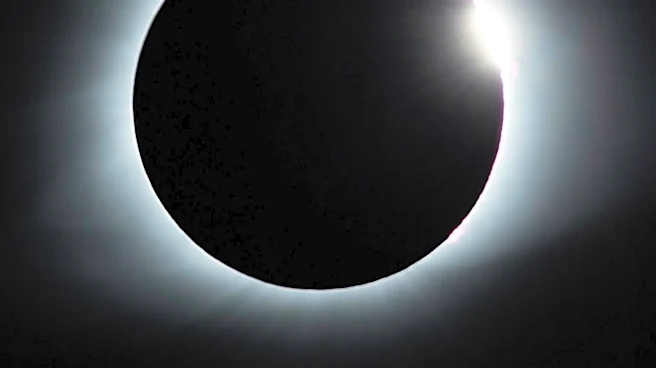
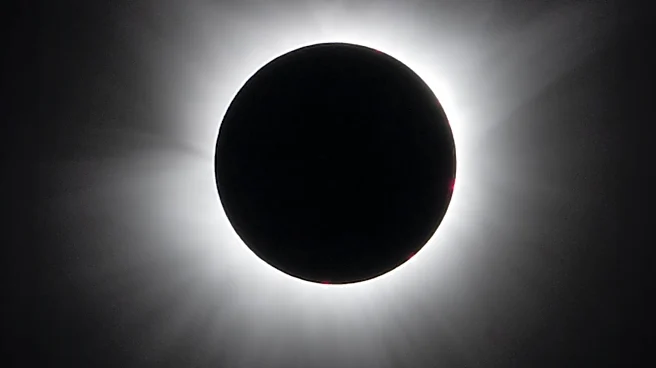
Researchers from the University of Pittsburgh are delving into the mystery of shadow bands, a phenomenon observed during solar eclipses. These bands appear as long dark lines racing across surfaces just before and after totality, when the moon completely
blocks the sun's light. David Turnshek, a professor of physics and astronomy, has been studying this phenomenon since witnessing it as a teenager. The prevailing theory suggests that atmospheric turbulence causes shadow bands, but recent findings from a 2017 eclipse challenge this notion. During that event, data collected from high-altitude balloons and ground sensors showed a consistent signal, indicating that diffraction-interference might also play a role. The upcoming solar eclipse provides another opportunity for researchers to study shadow bands, although cloud cover has previously hindered observations.
Why It's Important?
Understanding shadow bands could enhance scientific knowledge about atmospheric phenomena and light behavior during eclipses. This research has implications for astronomy and physics, potentially leading to new insights into how light interacts with atmospheric conditions. The study of shadow bands also contributes to broader eclipse research, which captivates public interest and encourages scientific exploration. By challenging existing theories, researchers like Turnshek are pushing the boundaries of scientific understanding, which could lead to advancements in related fields such as optics and meteorology.
What's Next?
Turnshek plans to travel to Spain for the upcoming solar eclipse, hoping to capture shadow bands using electronic detectors. Although logistical challenges prevent replicating previous experiments, he aims to gather data that could further clarify the phenomenon. Other researchers and eclipse enthusiasts are also preparing to observe shadow bands, using various methods to document their occurrence. The continued study of shadow bands may eventually lead to a definitive explanation, resolving the ambiguity surrounding their cause.
Beyond the Headlines
The investigation into shadow bands highlights the complexity of scientific phenomena, where multiple factors can contribute to observed effects. This research underscores the importance of interdisciplinary approaches, combining atmospheric science, optics, and astronomy to unravel mysteries. The study also reflects the collaborative nature of scientific inquiry, with researchers and citizen scientists working together to gather data and share findings. As interest in eclipses grows, public engagement in scientific research may increase, fostering a deeper appreciation for natural phenomena.