




What's Happening?
The U.S. Geological Survey (USGS) has reported ongoing earthquake activity and modest inflation at the summit of Kīlauea volcano in Hawaii. This follows an intrusion event that occurred between the afternoon of September 30 and the morning of October
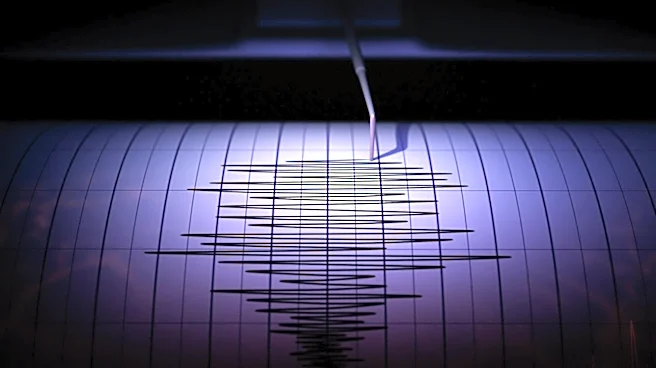
1. In the past 24 hours, 59 shallow earthquakes were recorded across the summit region, primarily beneath Halemaʻumaʻu, with the largest being a magnitude 3.5 earthquake on October 2. The Uēkahuna tiltmeter also registered approximately 4.9 microradians of inflation. Despite the continued seismic activity, there have been no overflows or spattering from the north or south vents in the last 24 hours, though strong glow and flames were observed overnight. A helicopter overflight after the intrusive activity concluded found no evidence of new ground cracking or lava eruption in a new location. The intrusion itself did not reactivate in the past 24 hours.
Why It's Important?
The continued seismic activity and ground inflation at Kīlauea's summit indicate that the volcanic system remains active and highly pressurized. This sustained unrest suggests a potential for renewed eruptive activity, either from the existing north-south-west vent complex or from a new vent within the caldera. While the current alert levels remain at ORANGE/WATCH, signifying heightened unrest with an increased potential for eruption, the unpredictable nature of these events poses ongoing hazards. These hazards include volcanic gas emissions, which can create vog (volcanic air pollution) affecting respiratory health, and the potential for tephra fall, which can cause skin, eye, and respiratory irritation. The possibility of new lava flows, though currently confined to Halemaʻumaʻu, also presents risks of burns and injuries from hot surfaces and uneven terrain. The instability of the Halemaʻumaʻu crater wall, exacerbated by earthquakes, also raises concerns about ground cracking and rockfalls.
What's Next?
Monitoring data suggests that Kīlauea's summit system remains active and highly pressurized. The two most probable scenarios are the continuation of activity at the north-south-west vent complex or the activation of another existing weak crack system in the summit region. The USGS notes that neither of these events is likely to produce a strong seismic precursor, meaning changes could occur rapidly with little warning. The alert levels are maintained at ORANGE/WATCH, reflecting the ongoing potential for eruption. HVO will continue to closely monitor Kīlauea and maintain communication with Hawaiʻi Volcanoes National Park and the Hawaiʻi County Civil Defense Agency to assess and communicate eruptive hazards. Residents and visitors are advised to stay informed about potential changes in activity and adhere to safety guidelines regarding volcanic gas, tephra, and ground instability.
Beyond the Headlines
The persistent unrest at Kīlauea underscores the dynamic and unpredictable nature of volcanic systems, particularly in geologically active regions like Hawaii. The ongoing monitoring efforts by the USGS are crucial for public safety and understanding the complex processes driving volcanic activity. The potential for rapid changes in eruptive behavior, even without significant seismic precursors, highlights the challenges in forecasting volcanic events. This situation also brings to light the broader implications for local communities and tourism, as volcanic activity can disrupt daily life, impact air quality, and necessitate park closures. The scientific data collected during these periods of unrest contributes significantly to volcanology, improving models and predictive capabilities for future events, not just in Hawaii but globally. The interaction between magma movement, ground deformation, and seismic activity provides valuable insights into the internal workings of active volcanoes.