




What's Happening?
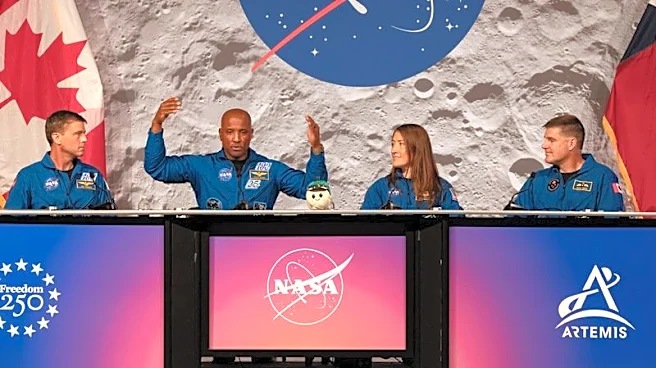
NASA astronaut Christina Koch, a member of the Artemis II mission, has been experiencing difficulties readjusting to Earth's gravity after her historic lunar journey. Koch, who became the first woman to travel around the moon, shared her experiences of struggling
with balance and coordination upon returning to Earth. The astronauts, including Koch, Victor Glover, Reid Wiseman, and Jeremy Hansen, have undergone extensive medical testing to assess their balance, vision, muscle strength, and overall health. These tests are crucial as they help understand the effects of space travel on the human body. Koch explained that the vestibular systems in the body, which help with balance, do not function properly in microgravity, leading to reliance on visual cues for orientation. This adaptation process is significant for future space missions and has implications for treating balance-related conditions on Earth.
Why It's Important?
The challenges faced by Christina Koch and her fellow astronauts highlight the physiological impacts of space travel, particularly the effects of microgravity on the human body. Understanding these effects is vital for the planning of future lunar and Mars missions, as it informs the development of countermeasures to protect astronauts' health. The insights gained from these experiences can also contribute to medical advancements on Earth, particularly in treating conditions like vertigo and concussions. The Artemis II mission represents a significant step in NASA's efforts to return humans to the moon and eventually send them to Mars, making the health and safety of astronauts a top priority.
What's Next?
As NASA continues to analyze the data from the Artemis II mission, the findings will likely influence the training and preparation of future astronauts. The agency may develop new protocols and technologies to mitigate the effects of microgravity on the human body. Additionally, the experiences of Koch and her team will be used to refine the design of space suits and equipment to enhance astronauts' performance during lunar missions. The ongoing research will also contribute to the broader understanding of human adaptation to space environments, paving the way for longer-duration missions beyond Earth's orbit.