




What's Happening?
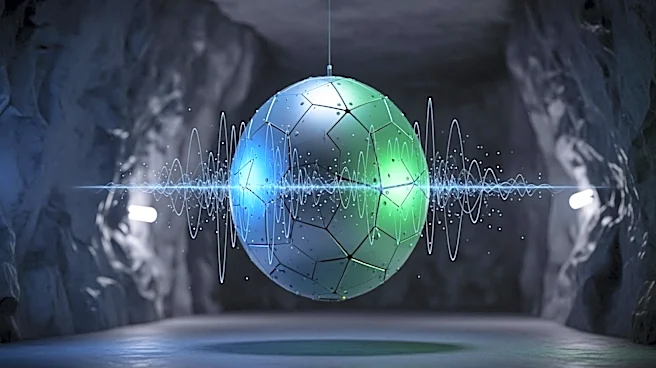
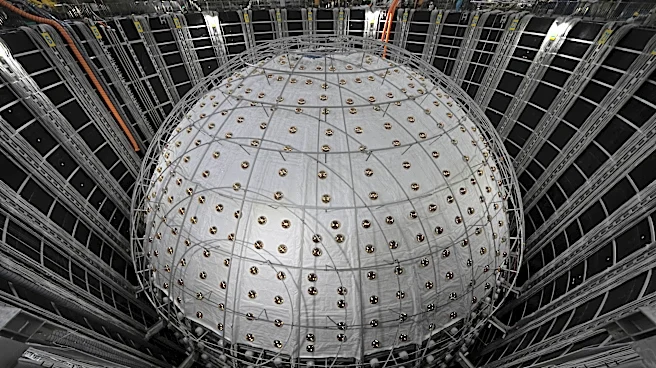
The Jiangmen Underground Neutrino Observatory (JUNO) in China has released its first major findings on neutrinos, often referred to as ghost particles. These particles, which date back to the Big Bang, are notoriously difficult to detect due to their
negligible mass. The JUNO detector, located deep underground, has been collecting data since August and has provided some of the most precise measurements of neutrino behavior to date. The study, published in Nature, highlights how neutrinos switch between different flavors as they travel through space. The findings are a significant step towards understanding the mass hierarchy of neutrinos, a longstanding mystery in particle physics.
Why It's Important?
Understanding neutrinos is crucial for advancing knowledge in particle physics and cosmology. Neutrinos are fundamental to the universe's structure, and insights into their behavior could unlock answers to questions about the universe's formation and evolution. The JUNO detector's findings contribute to a global effort to map the properties of neutrinos, with similar projects underway in Japan and the United States. These efforts could lead to breakthroughs in theoretical physics and enhance our understanding of the universe's fundamental forces. The research also demonstrates the potential of international scientific collaboration in tackling complex scientific questions.
What's Next?
The JUNO detector will continue to collect data, with scientists aiming to resolve the neutrino mass hierarchy. Future findings could provide more detailed insights into neutrino properties and their role in the universe. Additionally, upcoming projects like Japan's Hyper-Kamiokande and the U.S.-based Deep Underground Neutrino Experiment will complement JUNO's work, offering cross-verification of results through different methodologies. These projects are expected to begin data collection within the next decade, further advancing the field of neutrino research and potentially leading to new discoveries in particle physics.