






What's Happening?
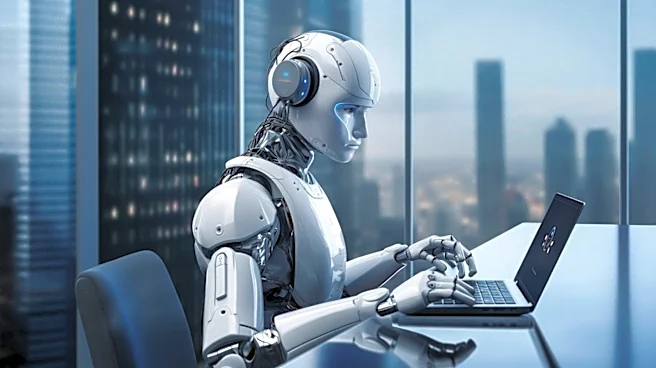
The blog post by Guanyang Wang discusses the evolving role of mathematicians in the era of advanced AI technologies. As AI continues to make breakthroughs in fields like combinatorics, the traditional role of mathematicians is being questioned. The post explores
whether AI will fully automate mathematical processes, potentially leading humans to become consumers rather than creators of mathematics. Wang suggests that if AI can complete mathematical tasks independently, the profession may face significant changes, with humans stepping back from intellectual creation. However, if AI requires human collaboration, there may still be opportunities for mathematicians to work alongside AI, using it as a tool to expand their capabilities.
Why It's Important?
The potential shift in the role of mathematicians due to AI advancements could have profound implications for the field of mathematics and related industries. If AI takes over the creation of mathematical theories and problem-solving, it could lead to a reduction in the need for human mathematicians, impacting educational institutions and research funding. Conversely, if AI remains a collaborative tool, it could enhance human capabilities, leading to new discoveries and applications across various scientific and engineering fields. This transition could redefine the profession, requiring mathematicians to adapt to new roles and skills.
What's Next?
The future of mathematicians in the AI era depends on the extent to which AI can automate mathematical processes. If AI becomes fully autonomous, educational institutions may need to adjust their curricula to focus more on AI collaboration skills. Research funding could shift towards AI development rather than traditional mathematical research. Mathematicians may need to explore interdisciplinary roles, bridging gaps between mathematics and other fields. The ongoing development of AI technologies will likely continue to shape the profession, requiring adaptability and innovation from mathematicians.
Beyond the Headlines
The ethical implications of AI's role in mathematics are significant. The potential displacement of human mathematicians raises questions about the value of human creativity and intellectual contribution. As AI becomes more integrated into mathematical processes, there may be concerns about the loss of human oversight and the potential for AI-generated errors. Additionally, the cultural shift in the perception of mathematicians from creators to consumers could impact the identity and motivation of individuals entering the field.