
What's Happening?
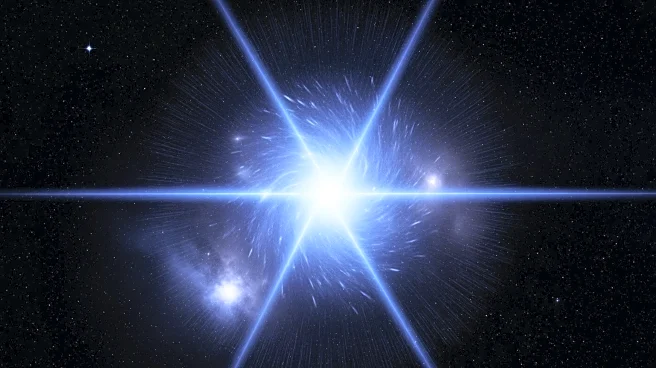
Astronomers are investigating a mysterious gamma-ray burst (GRB) spotted 13 billion light-years away from Earth. Detected by the Space Variable Objects Monitor (SVOM) satellite in March 2025, this GRB is unusual
due to its 10-second duration and repetition over 24 hours. Typically, GRBs last only milliseconds to minutes, caused by the collision of neutron stars or a neutron star and a black hole. This particular burst is believed to result from the explosive deaths of massive stars when the universe was only 730 million years old, as observed by NASA's James Webb Space Telescope.
Why It's Important?
The discovery of this rare gamma-ray burst provides valuable insights into the early universe, offering clues about the formation and death of massive stars. Understanding such phenomena can enhance our knowledge of cosmic events and the evolution of the universe. The ability to detect and analyze these distant events demonstrates the capabilities of modern astronomical tools like the James Webb Space Telescope, which can observe the universe's infancy. This research could lead to breakthroughs in astrophysics, potentially reshaping our understanding of cosmic history and the lifecycle of stars.
What's Next?
Astronomers are continuing to study this gamma-ray burst to uncover more details about its origin and nature. Further observations and analyses are expected to provide deeper insights into the conditions of the early universe and the processes leading to such rare cosmic events. The ongoing research may involve collaboration among international space agencies and the use of advanced telescopes to gather more data. As scientists work to unravel the mysteries of this GRB, the findings could contribute to broader astrophysical theories and models.