




What's Happening?
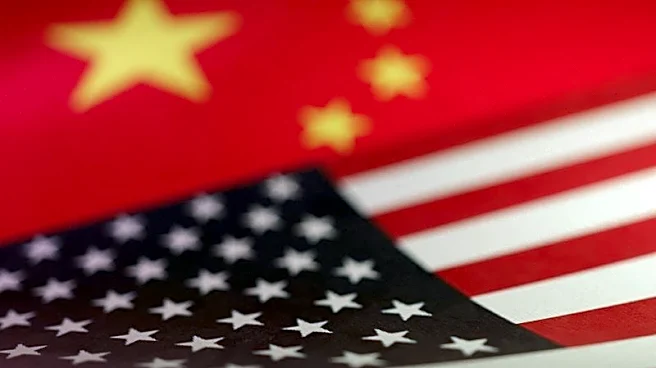
The U.S. is preparing to inform dozens of partner countries that they must align with either the U.S. or China in the artificial intelligence (AI) race. According to a U.S. official and an internal draft reviewed by Reuters, countries that join Beijing's
competing AI framework will be excluded from a U.S.-led AI coalition. This directive falls under the 'Pax Silica initiative,' launched last year by Washington to secure supply chains for AI models, semiconductors, and critical minerals, amidst an intense technological rivalry with Beijing. Approximately two dozen countries have already joined Pax Silica, including close U.S. allies like Japan, Australia, and South Korea. Kazakhstan is noted as the only country to have joined both the U.S. initiative and China's rival 'World Artificial Intelligence Cooperation Organization,' which was launched by Chinese President Xi Jinping in July to promote open-weight technology. The draft letter from the State Department, addressed to 35 signatories of a U.S. 'AI Opportunity Statement,' emphasizes that participation in Pax Silica is a commitment and cannot be held alongside membership in conflicting initiatives.
Why It's Important?
This U.S. policy marks a significant escalation in the technological and geopolitical competition between the United States and China. By forcing countries to choose sides, the U.S. aims to limit China's access to critical resources and expertise necessary for developing advanced AI, which could have profound implications for military and economic dominance. The 'Pax Silica initiative' is designed to create a secure and reliable supply chain for essential AI components, reducing reliance on adversaries. This strategy could reshape global alliances and trade relationships, as countries weigh the benefits and risks of aligning with either superpower. For U.S. industries, securing these supply chains could foster innovation and reduce vulnerabilities, while for countries that choose to align with China, it could mean exclusion from U.S.-led technological advancements and investment opportunities. The move underscores the strategic importance of AI as a critical technology that will define future global power dynamics, impacting everything from national security to economic competitiveness.
What's Next?
The U.S. State Department's letter, once formally sent, will likely trigger a series of diplomatic engagements as partner countries assess their positions and make strategic choices. Countries like Kazakhstan, which have dual affiliations, will face pressure to decide their primary allegiance in the AI domain. This could lead to a realignment of international technological cooperation and investment flows. China is expected to continue promoting its 'World Artificial Intelligence Cooperation Organization' and its open-weight AI technology as an alternative, potentially intensifying the competition for global influence. The U.S. will likely continue to push for joint projects and export controls among its allies to further consolidate its technological ecosystem. The long-term implications include a potential bifurcation of global AI development and supply chains, with significant consequences for technological standards, innovation, and economic interdependence. The situation could also lead to increased R&D investments in AI and related critical minerals as both powers strive for self-sufficiency and leadership.
Beyond the Headlines
The U.S. demand for allies to choose sides in the AI race extends beyond mere technological competition; it reflects a deeper ideological and strategic struggle for global leadership. This 'tech Cold War' could lead to the fragmentation of the internet and digital ecosystems, creating distinct spheres of influence with differing standards, regulations, and ethical frameworks for AI development. The ethical implications are profound, as the U.S. and China may develop AI with divergent values embedded in their systems, impacting privacy, surveillance, and human rights globally. Furthermore, the emphasis on securing critical mineral supply chains highlights the increasing geopolitical importance of natural resources in the digital age, potentially leading to new resource conflicts or strategic partnerships. The decision by countries to align with either the U.S. or China will not only affect their economic and technological futures but also their geopolitical standing and national sovereignty in an increasingly polarized world.