




What's Happening?
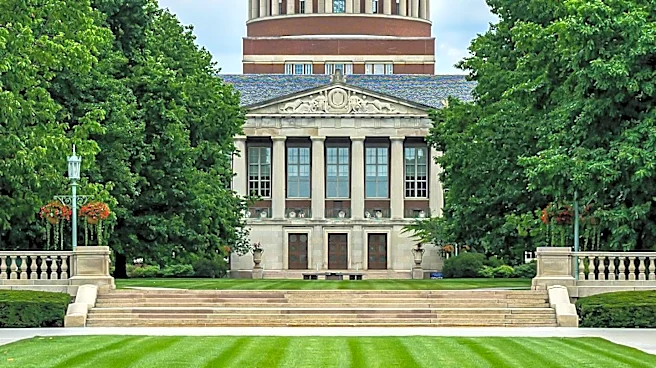
American universities are facing increasing scrutiny regarding the erosion of scholarly standards due to ideological commitments, particularly within the humanities and humanistic social sciences. A report commissioned by Daniel Diermeier, Chancellor
of Vanderbilt University, and Andrew D. Martin, Chancellor of Washington University in St. Louis, investigates whether preconceived assumptions are distorting the objective pursuit of knowledge. The report emphasizes the value of humanities in understanding human culture and society, and developing intelligent participation in society. However, it notes a trend where objectivity is being subordinated by two groups: those who view truth as relative, adopting ideas like 'my truth' and 'lived experience,' and those who abandon objectivity for political purposes, often associated with 'social justice warriors.' The latter group is criticized for distorting basic ideas of right and wrong and silencing dissenting views to promote specific ideologies. For instance, Ibram X. Kendi's definition of 'racist' in his book 'How to Be an Antiracist' is cited as an example of creating a new definition that deviates from established dictionary meanings, potentially to suit a particular narrative.
Why It's Important?
This discussion is crucial for the integrity of American higher education and its role in producing unbiased knowledge. If ideological commitments consistently override objective inquiry, the credibility of academic research and the educational foundation provided to students could be severely compromised. The debate highlights a fundamental tension between academic freedom and the pursuit of objective truth, with potential implications for how future generations are taught to analyze complex issues. The critique of figures like Ibram X. Kendi underscores a broader concern about how definitions and concepts are shaped within academic discourse, potentially leading to a lack of clarity and increased insecurity among individuals trying to understand complex social issues. The erosion of objectivity could also impact public trust in academic institutions, leading to a more polarized intellectual landscape where facts are selectively interpreted to fit pre-existing beliefs, rather than being used to form conclusions.
What's Next?
The report by the committee of scholars is expected to fuel further debate within academic circles and potentially influence how universities approach research and curriculum development. Institutions may face pressure to re-evaluate their commitment to objective inquiry and to implement measures that safeguard scholarly standards from ideological biases. This could lead to internal reforms, new guidelines for research, and a renewed emphasis on critical thinking that prioritizes evidence over predetermined conclusions. Public discourse around the role of universities in society is also likely to intensify, with calls for greater transparency and accountability in academic research. The ongoing discussion may also prompt a re-examination of how concepts like 'racism' and 'anti-racism' are defined and taught, potentially leading to a more nuanced and universally accepted understanding of these terms within educational settings.
Beyond the Headlines
The deeper implications of this trend extend to the very foundation of intellectual inquiry and societal progress. If objectivity is consistently dismissed or subverted, it could lead to a decline in the ability to solve complex problems through rational analysis and evidence-based reasoning. This shift could foster an environment where emotional appeals and ideological conformity take precedence over logical argumentation, potentially hindering scientific advancements and effective policy-making. Ethically, the abandonment of objectivity raises questions about academic responsibility and the duty of scholars to pursue truth without prejudice. Culturally, it could contribute to a more fragmented society where different groups operate with their own 'truths,' making consensus and mutual understanding increasingly difficult to achieve. The long-term consequence could be a weakening of the intellectual infrastructure necessary for a well-informed and critically thinking citizenry.