




What's Happening?
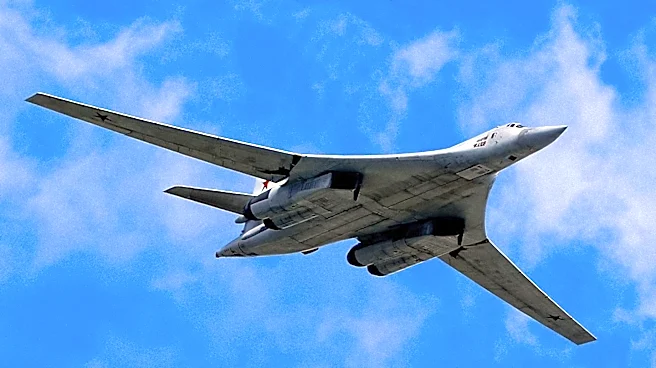
Russia continues to possess a robust nuclear triad, a strategic military doctrine designed to ensure retaliatory strike capability even after an initial attack. This triad consists of land-based missiles, submarine-launched missiles, and strategic bombers.
The concept of a nuclear triad emphasizes survivability and mutual assured destruction, serving as a cornerstone of nuclear deterrence. The development of this capability dates back to the Cold War era, specifically to August 29, 1949, when the Soviet Union successfully detonated its first atomic weapon, code-named RDS-1 or 'Pervaya Molniya' by the Soviets and 'Joe-1' by the United States. This event ended the U.S. monopoly on nuclear weapons and initiated a new phase of the Cold War, characterized by an arms race and the principle of nuclear deterrence. Today, Russia holds the largest nuclear arsenal globally, with approximately 5,459 nuclear warheads, slightly more than the United States' 5,177. These warheads are allocated across its land-based ballistic missiles, submarines, and strategic bombers, ensuring a comprehensive and diversified nuclear deterrent.
Why It's Important?
The existence and maintenance of Russia's nuclear triad are critically important for global security and U.S. foreign policy, particularly in the context of ongoing international tensions. The principle of mutual assured destruction (MAD), underpinned by such triads, has historically prevented direct military confrontation between major nuclear powers. For the U.S., understanding Russia's nuclear capabilities and doctrine is essential for strategic planning, arms control negotiations, and maintaining a stable balance of power. The current conflict in Ukraine has brought the nuclear threat back into sharp focus, with Russia's revised nuclear doctrine indicating a potential willingness to use nuclear weapons even in response to an attack by a non-nuclear state if supported by a nuclear power. This shift broadens the theoretical scope for deploying arsenals and blurs the lines of deterrence, posing significant challenges to international stability and requiring careful diplomatic and strategic responses from the U.S. and its allies. The continuous modernization of nuclear arsenals by both Russia and the U.S. underscores the ongoing relevance of nuclear deterrence in contemporary geopolitics.
What's Next?
The ongoing situation suggests a continued focus on nuclear deterrence and arms control discussions between major powers. The U.S. will likely continue to monitor Russia's nuclear doctrine and capabilities closely, adapting its own defense strategies and diplomatic efforts accordingly. International bodies and alliances will also likely engage in discussions aimed at de-escalation and establishing clearer guidelines for nuclear non-proliferation and use. The rapid expansion of China's nuclear arsenal, which could soon rival the intercontinental missile capabilities of Russia and the United States, introduces a new layer of complexity to trilateral arms control. This emerging dynamic will necessitate new approaches to defining parity and stability among three nuclear powers, a challenge distinct from traditional bilateral arms control frameworks. Future negotiations may need to address this trilateral competition to prevent a new arms race and ensure global strategic stability. The international community will be watching for any further revisions to nuclear doctrines and the potential implications for global security.
Beyond the Headlines
The concept of the nuclear triad extends beyond mere military hardware; it embodies a complex interplay of psychological, political, and ethical dimensions. The 'balance of terror' that emerged from the Cold War, where the fear of mutual destruction prevented direct conflict, highlights the paradoxical nature of nuclear weapons as instruments of peace through deterrence. However, this balance is inherently fragile, relying on rational actors and clear communication channels. The blurring of deterrence lines, as seen in Russia's revised doctrine, raises profound ethical questions about the conditions under which nuclear weapons might be used and the potential for miscalculation. The long-term environmental and health consequences of nuclear testing, exemplified by the Semipalatinsk site, serve as a stark reminder of the devastating human cost associated with these weapons, even without their deployment in conflict. The ongoing presence of vast nuclear arsenals forces humanity to confront its capacity for self-destruction and the continuous need for vigilance, diplomacy, and a commitment to disarmament to prevent a catastrophe that would transcend national borders and generations.