






What's Happening?
The Okefenokee National Wildlife Refuge, spanning southeastern Georgia and a portion of northeastern Florida, has been officially designated as a UNESCO World Heritage Site. This recognition marks the first time a property managed entirely by the U.S.
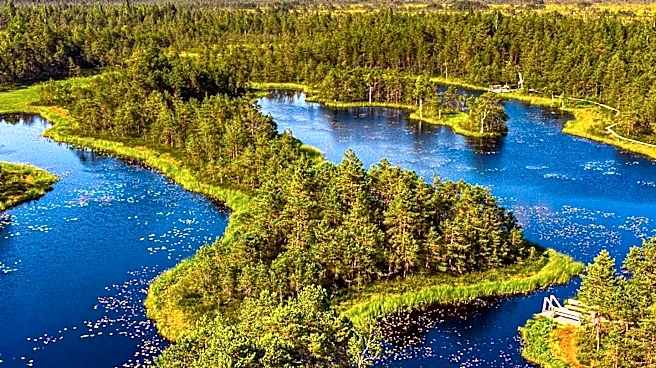
National Wildlife Refuge System has received such a designation. The Okefenokee, known as the 'land of the trembling earth' by Indigenous peoples, is one of the world's rarest surviving wetland ecosystems. Its inscription on the World Heritage List places it alongside other celebrated American landscapes like Yellowstone and Yosemite. The designation acknowledges the swamp's outstanding ecological processes and its importance for biodiversity, supporting over 1,270 plant and vertebrate species, including 24 globally threatened ones. The refuge's unique characteristics include its vast collage of open prairies, cypress forests, pine uplands, and its role in feeding the Suwannee and St. Marys rivers. Beneath its dark waters lies a significant accumulation of peat, formed over approximately 7,500 years, making it likely the world's largest and most intact lowland freshwater peatland in the subtropical zone.
Why It's Important?
The UNESCO World Heritage designation for the Okefenokee National Wildlife Refuge is significant for several reasons. Firstly, it brings global recognition to a unique American ecosystem, highlighting its ecological value and the need for its preservation. This international spotlight can increase public awareness and potentially garner political support and resources for conservation efforts. The Okefenokee's peat deposits are crucial as they store carbon accumulated over millennia, making its protection vital in the context of climate change. Disturbing these deposits could release stored carbon, impacting global environmental efforts. The refuge also serves as a critical habitat for a diverse range of species, including many that are globally threatened, underscoring its role in maintaining biodiversity. The designation also emphasizes the importance of natural processes, such as the interplay of fire and water, in shaping and sustaining the environment on a large scale, a rarity in a world where many natural landscapes have been significantly altered by human activity. This recognition can also inspire local pride and encourage responsible tourism, fostering a broader constituency committed to protecting the landscape.
What's Next?
While the UNESCO designation is a significant honor, it does not automatically provide new legal protections for the Okefenokee. The refuge's future will depend on continued conservation efforts and the translation of international attention into lasting support. The International Union for Conservation of Nature (IUCN) has recommended updating the property's management plan, strengthening coordination and monitoring, and ensuring more meaningful involvement of the Muscogee (Creek) Nation, whose historical and cultural connections to the region are vital. Long-term protection will also require adequate staffing, continued scientific research, and public education. Threats to the Okefenokee, such as development and changes in land use on surrounding lands, and shifts in rainfall and wildfire patterns due to climate change, remain. Conservation efforts will need to extend beyond the refuge's boundaries to account for interconnected water systems and wildlife habitats. The acquisition of nearly 8,000 acres of land and mineral rights in June 2025, which halted a proposed titanium-mining operation, demonstrates the ongoing need for vigilance and proactive conservation measures.
Beyond the Headlines
The Okefenokee's UNESCO designation highlights a broader ethical and cultural implication: the recognition of natural landscapes for their intrinsic value, rather than solely for their accessibility or dramatic features. The swamp's significance lies in its ability to operate on its own terms, with natural processes largely undisturbed. This challenges the common assumption that remarkable landscapes must be made more accessible to be appreciated, advocating instead for a deeper respect for wilderness and its inherent solitude. The involvement of the Muscogee (Creek) Nation in future management decisions underscores the importance of acknowledging Indigenous connections and traditional ecological knowledge in conservation. The Okefenokee's journey to World Heritage status, spanning over four decades, also reveals the complex interplay of science, politics, and funding in securing international recognition for natural sites. It emphasizes that while scientific evidence is crucial, political will and financial resources are equally vital for such endeavors. The ongoing threats to the Okefenokee, despite its protected status, serve as a reminder that conservation is a continuous process requiring sustained commitment from various stakeholders.