




What's Happening?
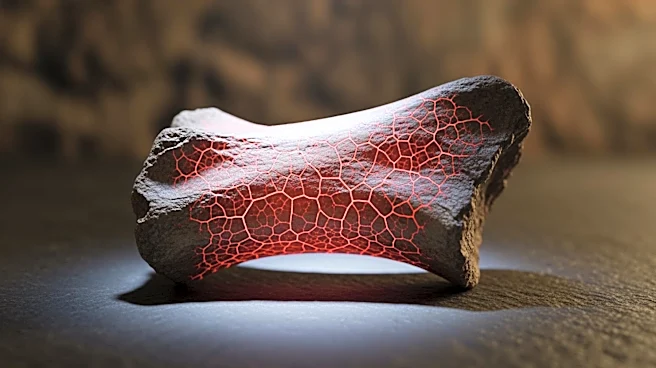
Recent research has uncovered preserved blood vessels in the bones of a Tyrannosaurus rex, providing new insights into dinosaur biology. The study, published in Scientific Reports, was conducted by a team of researchers using advanced 3D imaging techniques.
The preserved vessels were found in a specimen known as Scotty, the largest T. rex ever discovered, housed at the Royal Saskatchewan Museum in Canada. Scotty's bones showed signs of injury, suggesting that the blood vessels were part of the healing process. This discovery was made possible through the use of synchrotron light, a powerful form of high-intensity x-rays, which allowed researchers to visualize the internal features of the fossil with remarkable clarity.
Why It's Important?
The discovery of blood vessels in T. rex bones is significant as it provides a rare opportunity to study the healing processes and survival strategies of large predatory dinosaurs. This finding could also guide future fossil discoveries, as bones showing signs of injury or disease may be more likely to preserve soft tissues. The research highlights the potential of combining physics, paleontology, and advanced imaging technologies to uncover details about dinosaur biology that were previously thought impossible to study. This could lead to a better understanding of the evolutionary links between dinosaurs and modern animals, such as birds.
What's Next?
The research team plans to continue applying physics-based methods to improve fossil analysis. The findings may encourage paleontologists to target fossils with signs of injury or disease for further study, potentially leading to more discoveries of preserved soft tissues. This could enhance our understanding of dinosaur biology and evolution, as well as provide a basis for comparison with other dinosaur species and modern animals.