



What's Happening?
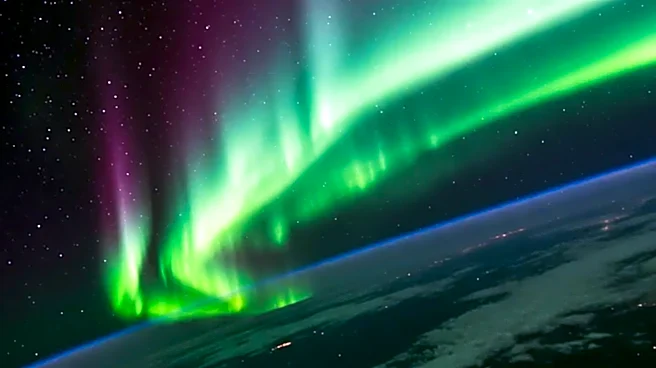
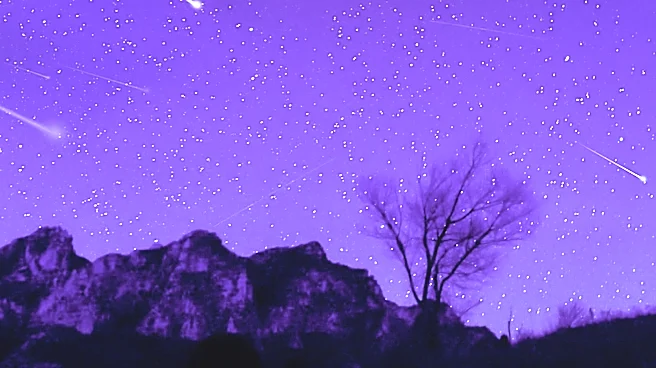
Photographs taken over Braunschweig and Göttingen, Germany, during the geomagnetic superstorm of May 10 and 11, 2024, have allowed scientists to trace the cause of both red and green auroras to a single mechanism. Bruce T. Tsurutani, formerly of NASA's
Jet Propulsion Laboratory, and his colleagues concluded that high-energy electron precipitation—electrons raining down along Earth's magnetic field lines—produced both sets of rays. The study, published on November 3, 2026, in Annales Geophysicae, addresses the long-standing mystery of what causes red auroras. The continuous rays observed in the photographs, taken with consumer cameras, argue against previous explanations involving heat conduction or heavy oxygen ions. This research marks the first time red and green auroras have been shown to be connected by continuous streaks, suggesting a unified cause for their appearance.
Why It's Important?
This research significantly advances the understanding of auroral phenomena, which are crucial for comprehending space weather and its potential impacts on Earth. Improved knowledge of electron precipitation mechanisms can lead to better predictions of geomagnetic storms, which can disrupt power grids, satellite communications, and GPS systems. For industries reliant on these technologies, such as aviation, telecommunications, and energy, more accurate forecasts could mitigate economic losses and enhance operational safety. The study also highlights the value of citizen science, as the photographs used were taken by amateur observers, demonstrating how public contributions can aid complex scientific investigations. Understanding these atmospheric interactions is vital for protecting critical infrastructure and ensuring the reliability of space-based assets.
What's Next?
The authors of the study have called for more close-up photographs of red auroras with exposures under 10 seconds to further validate their findings and explore other potential mechanisms. Future observations of red auroras without streaks or an underlying green aurora could indicate different causal factors, prompting further research into the diverse processes that create these celestial displays. Continued collaboration between professional scientists and citizen scientists could expand the dataset for auroral studies, leading to a more comprehensive understanding of Earth's magnetosphere and its interactions with solar activity. This ongoing data collection will be essential for refining models of space weather and its effects.
Beyond the Headlines
The study's findings challenge long-proposed explanations for red auroras, indicating a shift in scientific understanding of these atmospheric events. The reliance on theoretical arguments in the past, due to the difficulty of direct measurements, underscores the importance of observational data, even from non-specialized equipment. This development could influence how space physics research is conducted, potentially encouraging more citizen science initiatives in fields where direct measurement is challenging. Furthermore, the unified explanation for red and green auroras simplifies the understanding of these complex phenomena, making them more accessible to the public and potentially inspiring greater interest in space science and atmospheric research.