
What's Happening?
Hanukkah, also known as the Festival of Lights, is a Jewish holiday that lasts for eight nights, typically occurring in December. In 2025, Hanukkah will begin at sundown on December 14 and continue through December 22. The holiday commemorates the rededication
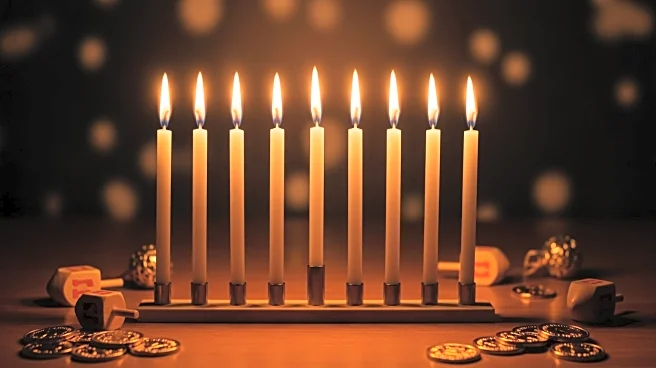
of the Holy Temple in Jerusalem over 2,200 years ago, following the Maccabean Revolt against the Syrian-Greek army. A key tradition of Hanukkah is the lighting of the menorah, a nine-branched candelabrum, with one additional candle lit each night. This practice symbolizes the miracle of the menorah in the temple, which remained lit for eight days despite having only enough oil for one day. Other customs include cooking foods in oil, such as latkes and sufganiyah, playing the dreidel game, and giving gifts, a tradition that has become more prominent in the U.S. due to its proximity to Christmas.
Why It's Important?
Hanukkah holds cultural significance, especially in the United States, where it is often perceived as a major Jewish holiday due to its timing near Christmas. This perception has led to the adoption of gift-giving traditions among American Jews, which is not historically part of Hanukkah. The holiday emphasizes themes of resilience and the triumph of light over darkness, resonating with broader societal values of hope and perseverance. The public lighting of menorahs in cities and parks has increased visibility and awareness of Jewish culture and traditions, fostering inclusivity and understanding in diverse communities. Additionally, Hanukkah's focus on charity and social works highlights the Jewish commitment to improving the world, aligning with universal humanitarian values.
What's Next?
As Hanukkah approaches, communities across the U.S. will prepare for celebrations that include public menorah lightings, family gatherings, and cultural events. These activities provide opportunities for education and engagement with Jewish traditions, promoting cultural exchange and dialogue. The holiday season may also see increased interfaith interactions, as Hanukkah and Christmas celebrations often coincide, encouraging mutual respect and appreciation among different religious groups. Retailers and businesses may experience a boost in sales related to Hanukkah gifts and decorations, reflecting the holiday's growing commercial aspect in the U.S.
Beyond the Headlines
The evolution of Hanukkah celebrations in the U.S. reflects broader trends in cultural adaptation and integration. The holiday's increased prominence and the adoption of gift-giving highlight how Jewish communities have navigated their identity within a predominantly Christian society. This adaptation underscores the dynamic nature of cultural traditions and their ability to evolve while maintaining core values. Furthermore, Hanukkah's emphasis on light and miracles can inspire reflections on contemporary challenges, encouraging individuals and communities to find hope and resilience in difficult times.