





What's Happening?
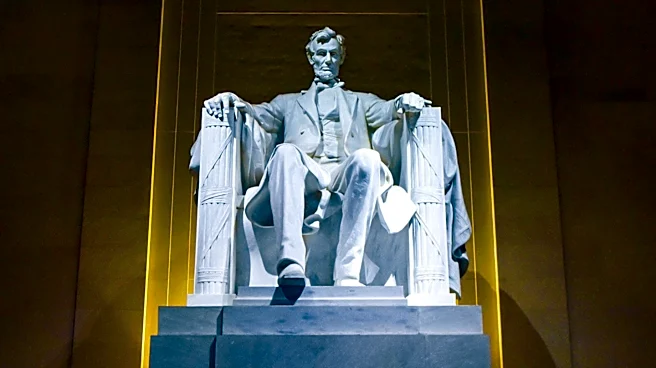
On November 6, 1860, former Illinois congressman Abraham Lincoln, representing the Republican Party, was elected President of the United States. Lincoln secured the presidency by defeating a field of candidates that included John Breckinridge, John Bell,
and Stephen Douglas. This historical event is noted as part of a broader 'Today in History' compilation for November 6, 2026. The election of 1860 was a pivotal moment in U.S. history, occurring on the eve of the Civil War. The Texarkana Gazette's 'Today in History' also mentions other significant events that occurred on November 6 throughout history, including Jefferson Davis's election as president of the Confederate States of America in 1861 and President Ronald Reagan's reelection in 1984.
Why It's Important?
The election of Abraham Lincoln in 1860 was a watershed moment that directly preceded the American Civil War, fundamentally altering the course of U.S. history. His victory, despite not winning a majority of the popular vote, highlighted the deep sectional divisions over slavery that plagued the nation. The defeat of candidates like John Bell, who represented the Constitutional Union Party and sought to avoid disunion by sidestepping the slavery issue, underscored the irreconcilable differences between the North and South. Lincoln's election prompted several Southern states to secede, leading to the formation of the Confederate States of America and the subsequent outbreak of war. This event remains a critical study in American politics, demonstrating how electoral outcomes can trigger profound societal and political transformations.
What's Next?
Historically, Lincoln's election led directly to the secession of Southern states and the commencement of the Civil War. The immediate aftermath involved intense political maneuvering, attempts at compromise that ultimately failed, and the rapid escalation of tensions into armed conflict. The long-term consequences included the abolition of slavery, the reunification of the United States, and a redefinition of federal power. For contemporary understanding, this historical event continues to be a subject of academic study and public discourse, offering insights into the fragility of national unity and the profound impact of political leadership during times of crisis. The legacy of Lincoln's presidency and the Civil War continues to shape American identity and political thought.
Beyond the Headlines
The 1860 election, with John Bell as a key contender, reveals the complex political landscape of a nation on the brink. Bell's Constitutional Union Party aimed to preserve the Union by appealing to a sense of national unity and avoiding the divisive issue of slavery, a strategy that ultimately failed. This highlights the limitations of political compromise when fundamental moral and economic issues are at stake. The election also demonstrated the power of regionalism in American politics, as voting patterns largely followed geographical lines. The outcome underscored the deep-seated ideological conflicts that had been simmering for decades, ultimately leading to a violent resolution. The historical narrative of this election serves as a powerful reminder of the profound consequences of political polarization and the challenges of maintaining national cohesion.