





What's Happening?
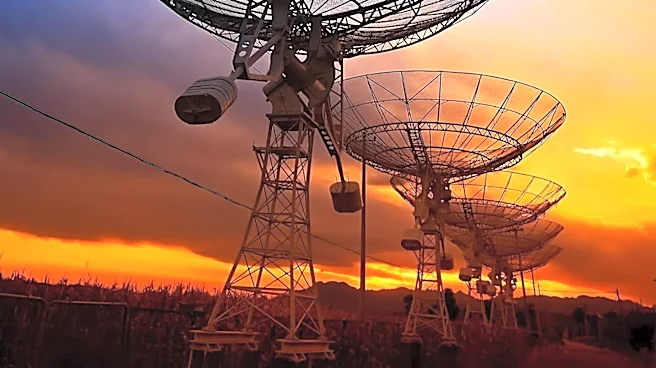
On March 10, 2026, astronomers using the NSF's Karl Jansky Very Large Array (VLA) detected polarized light at radio wavelengths from a gamma-ray burst (GRB) for the first time. This event, known as GRB 260310A, occurred when a star exploded inside a dense,
highly magnetized cloud of hydrogen gas. The detection marked the first observation of Faraday Rotation in a GRB, a phenomenon where polarized light twists as it travels through a strong magnetic environment. This discovery provides insights into the magnetic fields surrounding such cosmic explosions, which are believed to arise from the deaths of massive stars.
Why It's Important?
The detection of polarized light from GRB 260310A is significant as it allows scientists to directly measure the magnetic environment of one of the universe's most powerful explosions. Understanding these magnetic fields is crucial because they are thought to play a central role in powering gamma-ray bursts. This breakthrough offers a new way to study the conditions and environments that produce GRBs, potentially transforming our understanding of these extreme cosmic events. The findings could also help refine models of how massive stars end their lives and the role of magnetic fields in these processes.
What's Next?
Future observations of GRB afterglows with the VLA and other radio telescopes will enable scientists to monitor the evolution of magnetic field structures in real-time. This capability could significantly enhance our understanding of how relativistic jets form and how magnetic energy is released in extreme environments. Continued research in this area may lead to new insights into the physics of gamma-ray bursts and the life cycles of massive stars.