
What's Happening?
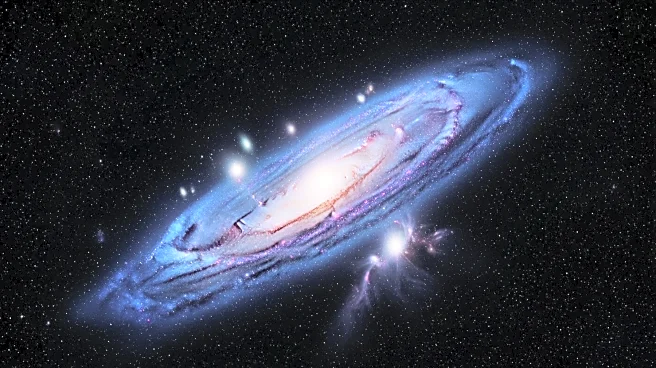
NASA's James Webb Space Telescope has delivered unprecedented images of the Circinus Galaxy, located approximately 13 million light-years away. The telescope's advanced capabilities have allowed scientists
to observe the galaxy's core in greater detail than ever before. The images reveal that the majority of the infrared emissions, previously thought to be from outflows, are actually from the areas closest to the supermassive black hole at the galaxy's center. This discovery challenges previous models and suggests that the hot, dusty material is feeding the black hole rather than being expelled. The research, published in Nature, marks the first extragalactic observation using an infrared interferometer in space.
Why It's Important?
This breakthrough in observing the Circinus Galaxy provides significant insights into the behavior of supermassive black holes and their surrounding environments. By understanding the distribution of infrared emissions, scientists can better comprehend the processes of accretion and outflow in active galaxies. This knowledge is crucial for developing more accurate models of galaxy evolution and the role of black holes in shaping their host galaxies. The findings also demonstrate the capabilities of the James Webb Space Telescope, paving the way for future studies of other galaxies and black holes.
What's Next?
The research team plans to apply the same observational techniques to study other black holes, aiming to build a comprehensive catalog of emission data. This will help determine whether the findings from the Circinus Galaxy are unique or part of a broader pattern. The James Webb Space Telescope will continue to be a vital tool in these investigations, offering the potential to unlock further mysteries of the universe.