









What's Happening?
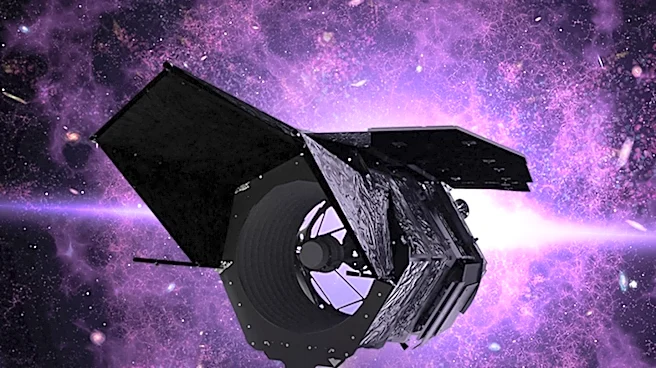
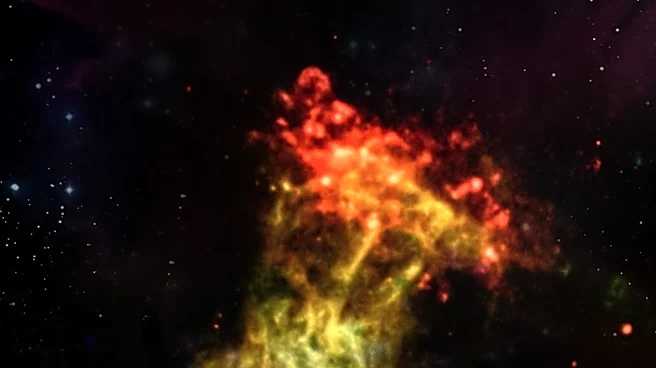
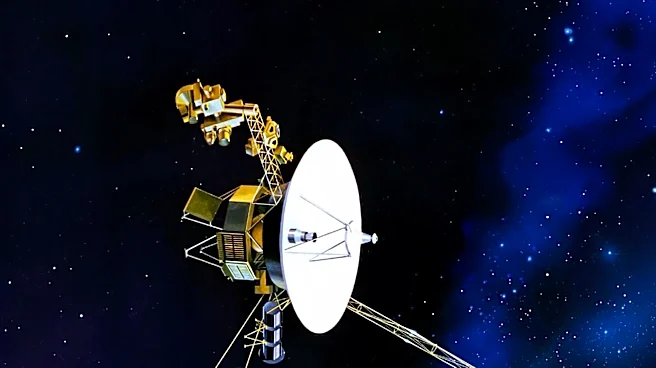
A team of researchers led by Hiroshima University has identified a source of extremely high-energy particles, known as a proton PeVatron, in the Milky Way. Using data from NASA's Fermi Gamma-ray Space Telescope and other observatories, the team confirmed
that the source, LHAASO J1912+1014u, is a proton accelerator. This discovery was made possible through multiwavelength observations and modeling, which provided a detailed picture of the source's characteristics. The findings, published in The Astrophysical Journal, highlight the source's ability to accelerate cosmic-ray protons to energies exceeding 1 quadrillion electron volts.
Why It's Important?
The identification of a proton PeVatron in the Milky Way is a significant breakthrough in astrophysics. Cosmic rays, which are primarily composed of protons, play a crucial role in cosmic events and the dynamics of the galaxy. Understanding their sources helps scientists unravel the mechanisms behind these high-energy particles and their impact on the universe. This discovery not only advances the field of astrophysics but also opens new avenues for research into other potential PeVatron sources in the galaxy. It enhances our understanding of cosmic phenomena and the fundamental processes that govern the universe.
What's Next?
Following this discovery, researchers plan to investigate other potential PeVatron sources in the Milky Way. The study of LHAASO J1912+1014u provides a framework for identifying and characterizing similar sources, which could lead to further breakthroughs in understanding cosmic rays. The team aims to conduct comprehensive examinations of other candidates, utilizing data from multiple observatories to refine their models and enhance the accuracy of their findings. This ongoing research will contribute to a deeper understanding of the universe and the forces that shape it.