




What's Happening?
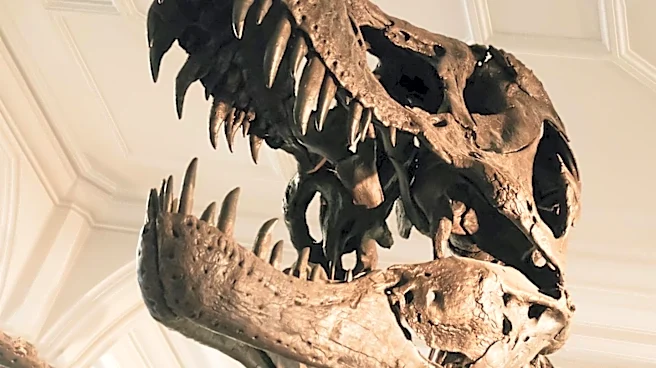
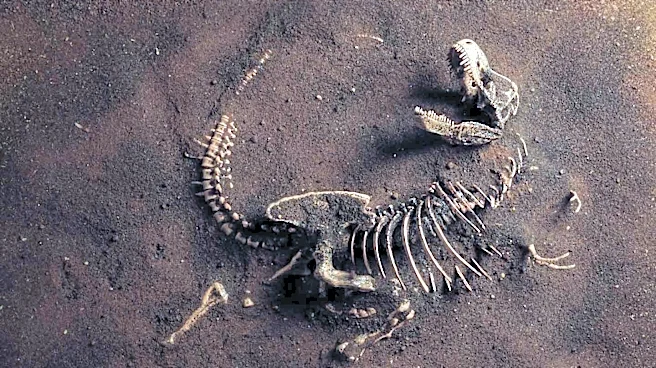
Researchers have discovered what may be 115-million-year-old traces of blood within the fossilized bone of Aratasaurus museunacionali, a carnivorous dinosaur from Brazil. The discovery, detailed in the Proceedings of the National Academy of Sciences (PNAS),
involves tiny oval shapes resembling red blood cells found within the limb bones of the approximately 3-meter-long, two-legged dinosaur. Chemical analysis at these sites revealed traces of heme, an iron-containing substance crucial for oxygen transport in blood. This association between the observed shapes and the chemical composition strengthens the hypothesis that these are ancient red blood cells. The team also analyzed surrounding rocks, finding different chemical signatures, which reduces the likelihood of contamination. This finding challenges previous understandings of how organic materials, such as blood, could be preserved over such vast geological timescales.
Why It's Important?
This potential discovery is significant for paleontology and our understanding of fossilization processes. If confirmed, it would represent an unprecedented level of organic preservation, offering new insights into dinosaur biology and the conditions under which such delicate structures can survive for millions of years. The presence of heme could provide direct evidence of the physiological characteristics of dinosaurs, potentially informing debates about their metabolism and internal systems. It also opens new avenues for research into fossil preservation, suggesting that more organic traces might exist in other fossils than previously thought. However, some specialists, like paleontologist Mary Schweitzer, remain cautious, noting that the observed shapes lack nuclei, a feature expected in the red blood cells of reptiles and birds, indicating that further confirmation is needed.
What's Next?
The scientific community is awaiting further confirmation of these findings, as not all specialists are convinced. An experiment is currently underway in Australia to investigate whether microbial mats, similar to those found in certain coastal environments, could facilitate the fossilization of blood. The results of this experiment could help clarify the specific conditions necessary for such ancient traces to be preserved. Future research will likely focus on developing more definitive methods to confirm the biological origin of these traces and to differentiate them from mineral replacements. If validated, this discovery could lead to a re-evaluation of existing fossil collections for similar organic remnants, potentially revolutionizing our understanding of ancient life.
Beyond the Headlines
The implications of this discovery extend beyond mere biological curiosity. The ability to preserve and detect such ancient organic molecules could fundamentally alter our understanding of evolutionary biology and the limits of molecular degradation over geological time. It raises ethical questions about the potential for extracting and studying ancient biological material, and the scientific community will need to establish guidelines for such research. Furthermore, it highlights the ongoing debate within paleontology regarding the interpretation of microscopic structures in fossils, emphasizing the need for rigorous chemical and structural analysis to avoid misinterpretations. This finding underscores the dynamic nature of scientific discovery, where long-held assumptions can be challenged by new evidence.